Author: admin

  • Men, and Singing in Church

    A small but consistent feature of our childhood was church on a Sunday morning; a small Anglican congregation in a rural village, not so much bucolic as simple and straightforward. My father, bless him, brought up a Presbyterian-by-rote, took to his first wife’s Anglicanism like a duck to water, and took attendance seriously. Moreover, and to his credit, he always did his best when it came to singing – and its something I remember very clearly.

    It’s notable to me because, subsequently spending many years leading congregations in praise and music, I’m very conscious that male singing is often missing. As a football fan, I’m convinced singing itself is not the problem – all men are capable of making a noise, and with practice – I mean, by doing it, not even necessarily by training – just about anyone can hold a tune.

    Writing in Christianity Today, Kelsey Kramer McGinnis correctly observes that this is partly an issue of musical tone – not just the key, but the whole tenor of modern praise and worship is geared towards higher and clearer male voices, and not the fuller baritone which most men possess. As someone with a fairly high tenor in my teens and early 20s, this suited me down to the ground; but as I’ve reached middle age and dropped a couple of tones, selfishly I too now find it increasingly difficult to sing newer songs with higher ranges, compared to the tried-and-tested settings of older hymnody. It remains surprisingly to hear modern worship in a deeper register – its why someone like Jordan Kauflin at Sovereign Grace, for example, sounds so unusual.

    The other issue, as well documented, is the ’90s–’00s proliferation of…. softer? lyrical content. We tread carefully here: one of the reasons behind the rapid rise of the toxic subset of new Calvinism, particularly in the US, twenty years ago was that it was pitched as an attempt to reclaim a more masculine Christianity, and the language and outcomes of such false teaching have been incredibly damaging. Nevertheless, I suspect one of the reasons that songs with more hymn-like language, along with bone fide psalm-singing, are currently increasingly popular (again)1 in my own Irish Presbyterian tradition is because men feel more comfortable declaring biblical truths in less poppy words.

    When visiting our church last November, Ligon Duncan made the claim that the only [Protestant] denomination in the United States which was experiencing growth was the more conservative Presbyterian Church in America (PCA). Why? One for the reasons, he said, is ‘in this kind of a culture, you better have a big God, with big truths, to be able to speak into this despair and discouragement that exists.’

    So too, I think, with singing. As someone who spends a lot of the time standing at the front, looking out across rooms of people singing, I’m convinced that men feel most encouraged to sing when the musicians meet them in the middle with hymns and songs that (a) are pitched musically at an appropriate register, but also (b) with content that declares a big God with big truths.

    As more and more men begin to trickle back to church, particularly amongst young adults, it is incumbent upon those who write, those who play, and those who lead to encourage the whole body of the church to sing. And it is incumbent upon men, fathers, brothers, uncles, grandfathers, to sing. Singing teaches truth which people remember for life. Singing unites heart and mind. Singing unites us together. God sang. You should try too.2

    1. Because, of course, this has all happened before: for example, the rise of ‘revival’ hymns and more emotional language in the late nineteenth century in the West, before a swing back to more traditional evangelical hymns in the mid-twentieth century, before the seeker-sensitive movement of the ’80s-’90s, before the CCM-heavy output of the end of the century, and so on. Back and forth. ↩︎
    2. And remember: even if you’re worried about how you sound, don’t be. No-one’s listening to you – they’re too busy worrying about how they sound themselves. ↩︎
  • 40×40 // 26 – Awkward Annie (2007)

    The start of summer. There was a time in life this meant the start of ‘summer teams’ season; packing off to a church hall somewhere for a week, or to summer camp, ready to run clubs for kids and teenagers. That slowly became festival season: first as a photographer; then as a production dogsbody on the A/V side; then, later, as an occasional venue manager, risk assessment in hand. All these things meant teamwork, regular all-nighters, too much coffee, and just trying to stay on top.

    In between duties, you might have often found me tucked away behind a stage somewhere, earphones in, breathing deeply and trying not to unload on whoever had sinned against my planning. As a result, I completely associate these moments in life with a seesaw mix of soothing alternative folk and rock bangers.1

    Kate Rusby’s album Awkward Annie epitomises the former – plenty of breathing space on an album of little episodic stories, best known for the lead single Planets but full of just enough lament to calm a racing mind down.2 A folk singer so talented, she should have been Irish.

    1. For example, summer means: I’d Rather Be With You and Better Together, but it also means The Ataris top class cover of Boys of Summer. ↩︎
    2. A special mention for the album recording of High on a Hill, featuring Chris Thile – one of the few mandolin riffs simple enough that even I can play it. ↩︎
  • 40×40 // 25 – The Night Song (2021)

    This particular day is a slightly unusual one. Tonight, my colleague Karen and I are due to be licensed as ‘probationers for the Christian ministry’ – aka, we’ve just completed three brilliant years of formal training at Union Theological College, alongside placement in various churches,1 and now are accredited in our home church to go and serve in our new one as assistants.

    This month has been full of them, and we’re the last out of the gate. It’s also a little unusual (these days) because both of us have come from the same church, where we were (at the moment of writing, still technically are) elders, so double the fun.

    Like most of the services of this kind, it is mostly other people doing things: except in the middle, where we are licensed – we come up and answer a series of questions publicly to affirm we understand and commit to our profession of faith and working within the Presbyterian system. This week – even though I’ve heard them several times recently – I was looking back over the questions we will be asked,2 and I stuck a little on the second one:

    ‘So far as you know in your own heart, have you been induced to seek the office of ministry from love to God and from a sincere desire to win souls to Christ and to promote God’s glory?’

    I paused a little to examine myself. Is this the reason I have gone through all this? Or could it be for less altruistic reasons? Job security? A certain type of status? The opportunity to badger a captive audience? And so on…

    One of the motivators in my life to ultimately pursue ministry was the slow, dawning realisation that, like most professions, those whose serve the church as pastors and teachers do not (or should not) feel any more like an expert than the rest of us. Each are talented in different ways. Some are great explainers of things. Others are talented personal evangelists. Some are natural entertainers. Others are more cerebral. And actually, within a local presbytery – group of ministers and elders – it is most useful to have a healthy range of these things.

    During weeks like this one, where I have felt fairly inadequate, this is always an encouragement.

    The Night Song is a lesser known collaboration between CityAlight and legendary (in a particular niche!) singer-songwriter, Colin Buchanan. The first time I tried playing it through for our littlest kids, it completely threw me emotionally, but we soldiered on. It is a quiet little song, a lullaby really, but psalmic in its lyricism as it reminds us that God will keep us, no matter the circumstances.

    For the first few years of parenthood, I always felt a little silly singing to our kids, despite (as long-term readers will know) taking far too much pride in my relatively short and completely insignificant time as a gigging musician. Yet once I got over the hump, it is a great source of learning and of enjoyment. Little songs like this allow even someone who feels shy about it – like me – to teach some simple truths that people might carry for the rest of their lives. Because they so often do.

    On occasions, when I have been privileged to sit beside someone coming towards the end of their life in a care setting, these types of songs are the ones that come to mind. People do not often find comfort singing elaborate worship pieces. They sing, Jesus loves me, this I know. They sing, The Lord is my shepherd. I suspect, in a few decades, some may sing, Jesus says when I am lost, I should come to him or maybe even something like The Night Song. And it is a most holy thing to be with them, and even to join in, when they do.

    So I will attempt to sincerely answer the question above, as worded, when we are licensed later, with memories like this in mind. Of sitting beside our youngest, tapping away on the piano and singing to her that God will hold her through the night. Of sitting beside an older person as she began whispering to herself, I to the hills will lift mine eyes. Of preparing to speak this Sunday evening on the gift of faith, freely given, to all who will place their trust in something outside of themselves. Does this qualify as winning souls and promoting God’s glory? Perhaps it does – one quiet, holy moment at a time.3

    1. Shoutout to the heroes of First Dromara, Ballysillian, Dundonald, and our current home at Hill Street. ↩︎
    2. Paragraph 291.1.3 if you’re interested! ↩︎
    3. 1 Kings 19:11–13 (NIV) – The Lord said, “Go out and stand on the mountain in the presence of the Lord, for the Lord is about to pass by.” Then a great and powerful wind tore the mountains apart and shattered the rocks before the Lord, but the Lord was not in the wind. After the wind there was an earthquake, but the Lord was not in the earthquake. After the earthquake came a fire, but the Lord was not in the fire. And after the fire came a gentle whisper. When Elijah heard it, he pulled his cloak over his face and went out and stood at the mouth of the cave. Then a voice said to him, “What are you doing here, Elijah?” ↩︎
  • 40×40 // 24 – The Stars Over Kinvara (2021)

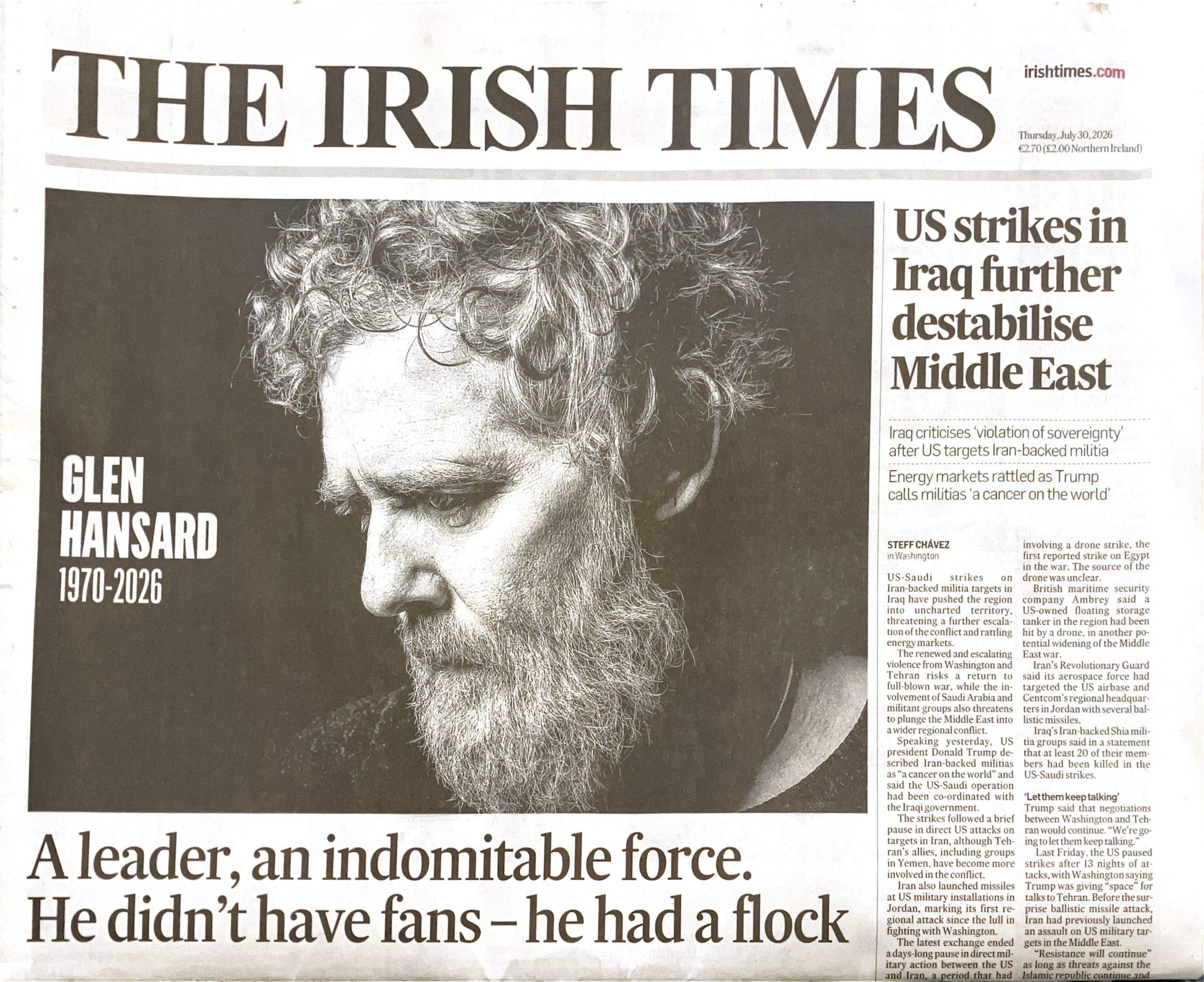
    Probably around 2005 or so, a uni housemate lent me Songs from a Room 2, the second CD compilation from the RTE series Other Voices. Other Voices walked so that things like NPR’s Tiny Desk Concerts could run, honestly. Glen Hansard presented the first series. That second album had a number of artists I ended up trying to see live, and some songs that stayed with me a long time: the electrifying Your World by Declan O’Rourke being one of them.

    Years later, and with Father’s Day looming this weekend, I’m minded of another of Declan O’Rourke’s songs: the deeply moving The Stars Over Kinvara, a meditation on fatherhood and the sense of reflection it instigates, and the connection it curates, upon one’s own place in time and space. The eponymous recurring line in each chorus lands perfectly.

    I only discovered this week that it was produced by Paul Weller, but that fits too: it has an acoustic guitar tone you would sell your house for.

  • On Institutionalisation

    Rev. David Cupples – a man whom I greatly admire – inadvertently ended up making the final speech at this year’s General Assembly of the Presbyterian Church in Ireland, which concluded today. I produce the transcript of it here in full. Speaking without notes, David said:

    “Moderator; members of Assembly – 

    “You can have the most beautiful trellis in the world, but you might have no vine to hang on it.

    “I believe – the former moderator said the other day, that he didn’t know what was going on in the heavenly realms. I’m going to be a little less humble, and a little more provocative; because I think I do know what is going on in the heavenly realms.

    “This is my forty-first General Assembly; I’ve received forty-one ‘Blue Books‘. If they average 300 pages, that means I’ve received 12,300 pages of reports. In the last four years, I’ve waded through every single page; and prior to that, I did my best.

    “This is possibly the last speech of the General Assembly. I didn’t intend it that way. I believe that we have been thoroughly, absolutely, and entirely institutionalised. We have been given what we perceive to be instruments of power: commissions, reviews, task groups, committees, and so on, and so on; and during my life I’ve spent an enormous amount of time in all those things, and understand their importance and value. But, like the start of The Lord of the Rings, where the rings of power were given – ‘three to the elves, seven to the dwarf lords, and nine to the race of men, who above all desire power’ – we’ve been given these instruments of power. But then, the introduction goes on, and Galadriel says, ‘But they were all of them, deceived.’ Because in the darkness, the dark lord, Sauron, forged a master ring to control them all. 

    “’One ring to rule them all; one ring to find them; one ring to bring them all, and in the darkness bind them.” We have been bound by institutionalism. What we need is to be revitalised, and I would like to leave you with this truth (an indisputable, and incontrovertible truth) at the end of this General Assembly. And it is this: all spiritual life and growth comes from an encounter with God. That’s a fact.

    “Sound doctrine, on its own, does not produce life: it’s necessary, but it does not produce life.

    “Good church order may preserve life, but it doesn’t produce it.

    “And new ideas may convey life, but they don’t produce it.

    “And I have one plea. How do I know we have been institutionalised? Sustained, united, corporate prayer has gradually disappeared from every aspect of our church’s life to the margins. And I believe we can do everything stated at this General Assembly in the future, but I passionately believe that if sustained, united, believing corporate prayer is not put back at the centre of church life, it will all be in vain.”

  • 40×40 // 23 – King of Wishful Thinking (1990)

    There’s no deep reason behind selecting this song. It’s poppy. It’s fun. It’s a cult classic. It makes me happy. And the lyric is actually fairly moving in isolation – the narrator attempting to talk himself out of his heartbreak.

    The New Found Glory cover is incredible.1 The shot-for-shot remake with Paul Rudd (also on vocals) and Jimmy Fallon is dedication to the bit par excellence.

    Sometimes our attachment to music (or any piece of creative art) is because of its relationship to a significant moment in our life, or the emotion it provokes. Or both. And sometimes, it’s simply because it slaps.

    1. There are some bangers, generally, on NFG’s From the Screen to Your Stereo records – if we’re picking another, let’s say Stay with Lisa Loeb also re-recording her vocals. ↩︎
  • 40×40 // 22 – Standing Outside the Fire (1993)

    World Cup Fever has officially taken hold in our house, as we await the tournament kick-off, one week from today.1 I was chatting to some folks earlier in the week whose first tournament memory was France ’98 – a good one – but I go back four years earlier to USA ’94, and specifically Ireland getting out of the group stage only to lose to the Netherlands in the next round. There’s still a branded USA ’94 McDonald’s toy knocking around somewhere.

    The tournament famously ended with Roberto Baggio missing his penalty to hand the trophy to Brazil. My memory is that it was on TV late – certainly post-bed-time for seven-year-old me – but I saw it all thanks to my partner-in-crime, my Nana. We were staying “down home” for a few weeks over the summer, as usual, but as soon as my parents went up the street for the evening to the pub, Nana would let me sneak up to watch TV: and seeing the Seleçāo lift the trophy is a core childhood memory.

    The same summer, Nana was at peak fandom – Garth Brooks fandom. And the other thing I remember sitting up to watch with her was a Brooks concert film on TV, which she loved. It’s not my favourite Garth Brooks song,2 but the one that I have the clearest memory of was her awe at his hit, Standing Outside The Fire – and a key debate about whether, for the particular performance on show, he was wearing flame-retardant trousers!

    Listen, Garth Brooks sounds cheesy, but will be forever associated with this favourite aspect of my childhood, so it is cemented in place. Nana passed away when I was nine, so memories aren’t always the clearest. Several memories endure: I picture her laughing at my cousins and I dancing around the kitchen, someone blasting tunelessly into a mouth organ; picking gooseberries off the bushes in her playground of a garden; shaking her head at us messing around at the summer scheme we were sent too, where I think she was helping out as first aider.

    I remember her appearing on the Late Late Show along with half the town, and this being A Big Deal. I remember her tutting at my uncle Bobby for filling us up on ice cream (HB sliders, cut straight from the block) on the way home from the bog, before we’d had our dinner. I also remember her, towards the end, struggling to vocalise as she fought aggressive cancer from her hospital bed in Dublin. But I prefer to remember her lastly, standing, silhouetted in the doorway, waving us off as we set off on the long journey back up north each time we left.

    And she loved Garth Brooks, and his potentially-flame-retardant trousers. So this one’s for her.

    With some of the gang – August 1994. That red cummerbund was the source of a legendary falling out.
    1. I count at least three wall charts already erected on the wall, but pride of place, as always, goes to the latest design by Elliott Quince. Elliott has been selling his wall charts for years to raise funds for Luton & Dunstable Hospital’s Neonatal Unit, and his charts are the best – you might still be able to get one here. ↩︎
    2. I endured a lot of Garth Brooks at his peak – the Irish love him – but it’s a toss-up between the humour of Friends in Low Places and the absolute caricature of Callin’ Baton Rouge. ↩︎
  • 40×40 // 21 – Mulholland Drive (2012)

    It would be stupid to try and tell you that the music you’re listening to is like nothing you’ve ever heard before. The songs on the Gaslight Anthem’s latest album are three or four minutes long, most of them, and they’re played on loud electric guitars, and there are drums, and to be honest, if you haven’t heard anything like this before, then you’re probably listening to the wrong band anyway.

    So writes Nick Hornby on the liner notes for the 2012’s Handwritten, an album which serves as an unflashy advertisement for why long-play records are not simply a collection of desperate tracks thrown together, but rather (at their best) a narrative arc strewn across anything up to and around 70 minutes of singing and playing. I could’ve picked any number of tracks from this album at random, but I’ve plumped for Mulholland Drive primarily because the lead guitar riff at the end is simple, but a lot of fun, to roll your fingers over.1 Four minutes of tight rock, get in and get out.

    I used to have a back-and-forth with someone about which band would be the most fun to be in. My stock answer, when I thought I was being pretentious (!), was Dave Matthews Band – a jam band, playing the same songs a different way every night. But actually, I have neither the stamina, talent, or hand span for that kind of thing. The better answer is The Gaslight Anthem. The songs are good; they are crafted to be short, with no baggy-ness; and most middling musicians can play them. That’s not meant as a slight, but a testament to musicians who write good songs and play them well.

    In this respect, The Gaslight Anthem are spiritual heirs to their hero, Bruce Springsteen – there’s a great clip of the Boss joining them to play their first big single, ’59 Sound at Glastonbury years ago,2 and the mood generally fits well with the Boss when he’s in his Born to Run mood. It’s clever, but not showy; the words are carefully chosen – so many literary references – but not pretentious. It’s good, healthy rock music for a Friday afternoon, and I, for one, am here for it.

    1. I like this album because the theme of songs and songwriting, and what that gives and takes from the writer, runs throughout. Tracks like “45”, Handwritten, and Too Much Blood put the theme front and centre – with that it mind, it makes so much sense that they got the author of High Fidelity on board. Someone’s posted the full liner notes here. ↩︎
    2. Found it. Love the look on lead singer Brian Fallon’s face throughout, having the time of his life. ↩︎
  • 40×40 // 20 – Decatur, or Round of Applause for Your Step-Mother! (2005)

    Some time early in 2014, after we’d been away, come back, and slowly slotted back into a life that had only just been getting started in Belfast. At some point, Andrew got in touch with a booking slot for a folk night he was hosting downtown. I think I was probably very flattered – I had not played out and about for a few years – and quickly got in touch with friend Robin. Get the old band back together? Sort of? A few covers, a few originals, sure it would be fun.1

    I have three core memories of the evening in question. The first, sitting (why did we sit?) behind the mics, looking out, thinking, ‘This isn’t working.’ The second is glancing over to Andrew, behind the sound desk, who looked like a man questioning his life choices. And the third was plopping down in a seat beside Hannah, who had kindly called down with a friend to check the night out, and responding to her consoling kind words with a, ‘I think I’m done.’ And I was. I’ve not played my own stuff anywhere since.

    Yet, on reflection, there were many redeeming factors. One, the people mentioned above are all awesome. Two, the symmetry of playing a final gig with Robin, having also played the first one with him all those years before, was perfect. When I had reached out to him, I’d said something like, ‘You pick a couple.’ We had a ton of fun practicing in the caravan parked up at the house which he was renovating at the time, trying to absolutely nail the harmonies on Sufjan Stevens’ Decatur – what could be more enjoyable?

    It’s often the simply little songs that are the most interesting – I was just listening to Damien Dempsey’s magical cover of A Rainy Night in Soho, a song with a three chord loop that stretches on and on, and yet as the layers build is (I think) captivating. Decatur is similar: in one sense, its meanders along for three minutes, but as it does so it is both slightly ethereal and, mainly, fun.

    When did music stop being fun?

    Well, it wasn’t fun that night in 2014. ‘I had my fill, and I know how bad it feels.’ But these days, listening to various sounds rattling around this house as the kids hammer on this or attempt to tinkle on that, it might be coming back around again.

    1. Was footering around with hard drives yesterday and dug out this. Some time in the late 2000s, we were hanging out and wrote and recorded a song called Evergreen. I hate listening to my strained voice, but Robin’s guitar sounds lovely. ↩︎
  • 40×40 // 19 – Dare You To Move (2000)

    Child #1 had a birthday (in the middle of exams this week), and amongst other things, his gifts included what has now become routine – a wadge of second hand CDs, sourced online, filling out his catalogue. Someone can be proud of their children for many things, but his growing ability behind a drum kit, and the fact that, when quizzed who is favourite band are, on many given days he might say Jimmy Eat World, reassure me that, as a parent, we’ve gotten some things alright.

    He is – I am convinced – the foremost expert in the land on something a little more niche: the oeuvre of alt rockers Switchfoot, and it began with the discovery on our shelves of their best-known album The Beautiful Letdown, including the reworking of their best-known song: Dare You To Move. I thought about some of the other awesome tracks Switchfoot have recorded, but its hard to get past it.1

    The Beautiful Letdown has had so many plays, we are genuinely on our third copy of the disc – the first being my own, from twenty-something years ago. We – he – now possesses everything they’ve committed to plastic. So in honour of birthday week, it had to be Switchfoot.

    It didn’t start there though. It started with Colin Buchanan, then Semisonic, as mentioned previously. It progressed through a short-lived family room routine, dancing around to the absolutely sensational Gregory Porter jam, Liquid Spirit, then later into a mini-U2 obsession and finally indoctrination with John Mayer and Jimmy Eat World. Been trying to get him into The Gaslight Anthem just this week.

    They say your children are the distillation of your best and worst traits. If one of my worst is early-century soft rock, then its absolutely true.

    1. I have a soft spot many of their tracks, including Ammunition off the same album, and from much later, the re-recording of their album track Won’t Let You Go featuring Lauren Daigle. ↩︎