Category: 2026

40×40 // 30 – Landed (2005)

In my current place of work, I get a little kick from being able to print something at one end of the building, and then go and collect it from the other. You know, networks and stuff.

But it led me to reflect this lunchtime on another era. When I was an undergrad1, both using the Web and printing anything required a journey across the street, and up four floors the computer lab on Elmwood Avenue. This led to numerous long afternoons half-heartedly tapping away at a workstation; but, part-way through first year, I developed an addiction to Yahoo! Music which became my coping mechanism, pumping music and videos into a little window in one corner of the screen as I was probably trying to write about cinema on the other.

Several favourite artists were discovered this way, but when Ben Folds’ album Songs for Silverman dropped in 2005, it quickly became a favourite.

Folds plays the piano. Hard. Not the rhythmic chords of modern praise and worship – full on melody. But hard. It falls into an interesting space, because it’s not the rock piano of either the T4-friendly US teen shows,2 nor the symphonic madness of a band like Muse. Folds sounds just right alongside Regina Spektor.3 But also is not adverse to screaming. Or playing with Weird Al. It’s a particular niche.

This particular, nerdy piano player (me, not him) particularly appreciated Songs for Silverman, and especially the lead single. It’s perhaps a more melancholy and reflective record than most of what came out of Ben Folds Five. I learnt it off, and it became a little standard for my own practicing: if I could get the lines up to speed, I knew I was getting somewhere.

Listening back, 20 years later, it’s probably neither as sophisticated or ground-breaking a song as I thought when I was 19. Few things ever are. But that piano sound was one I carried with me for years, subconsciously emulating (or trying to emulate) in everything from alt rock to church settings. Some things remain warm in your memory because they represent an important memory or emotion. But some things just end up written into your bones.

  1. I want to add, ‘the first time’, mostly as an acknowledgement of my wife’s cyclical suffering at the hands of my relationship with higher education. ↩︎
  2. For a segment of the population in their 30s and early 40s, this is a meaningful definition. Gavin DeGraw singing I Don’t Wanna Be. Phantom Planet’s California. Augustana and Boston or All the Stars and Boulevards. These are all songs that could be redeployed to impress people at open-mic sessions, because they would realise they knew them from their Sunday afternoons on the sofa. IYKYK. ↩︎
  3. Their collaboration on Dear Theodosia is the best Hamilton Mix Tape cover, and I will die on that hill. I don’t know why there isn’t an entry on 40×40 for Regina Spektor: Samson is one of the most achingly beautiful and sad things ever committed to iPod; forever associated in my head with a New Year’s Eve party, and all my girlfriends cool-seeming friends. ↩︎

40×40 // 29 – Mrs Potters’ Lullaby (1999)

Though I am not a big concert-goer (in terms of big concerts and big ticket prices) there are a couple of regrets from my bucket list. One was missing The Frames at Botanic Gardens a few years’ back, in what (it turns out) was their last visit to Belfast.1 Another was Nickel Creek at the Empire a few years before that.

And certainly, missing Counting Crows at their peak in 2009 is right up there. I’m reminded of it each year when I log on to BakeBook and am greeted by one of those ‘on this day’ posts at the top – wherein a school friend tagged me in a photo of him grinning beside an amped-up Adam Duritz after a show in Belfast.

Songwriters tell stories. A pal from years back, Andrew Farmer, has just released a new record today, Ochre, which encapsulates this – stories on a theme. An interesting twist, constantly revisited, is when songs which, rather than being full of vapid one-liners or platitudes, crossover into the mainstream.2 Often, its most prevalent in songs of heartache;3 but it can be most successful when its not, or when those songs of heartache are dressed up in a melody that sounds the opposite.4

Enter Counting Crows, and Mrs Potter’s Lullaby.

The story of this song is phenomenally quirky. Adam Duritz often wrote (and named) songs after real people – but this one is extreme. In brief: Adam Duritz was smitten by the actress Monica Potter, who starred in a number of movies in the late ’90s, and penned this song about an imaginary version of her. Completely unrelated, he then ends up in a room with her, and the song comes up. He is completely embarrassed; but she comes back to the studio to hear it, and makes off with a rough demo.

A few weeks’ later, Duritz hates the song. They can’t make it work. It’s overmixed and overwrought. He tells Monica Potter this – she disagrees and replays the original recording, which only she had.

‘Well, I’m going to need to borrow that,’ says Adam. And the rest is history.

Honestly, if it was an indie movie you’d consider it contrived. The narrative about the song is nearly as good as the narrative of the song itself. And the song itself is splendid.

  1. This was due to the impending birth of a child: a very good reason, I need to be clear, to not be milling around in Botanic. ↩︎
  2. Been spinning Phoebe Bridgers’ Lost Weekend all week – talk about narrative. Bobby is the pick of the bunch I think. ↩︎
  3. Let’s see now, what can we mention here in order to get a space on our Spotify playlist: Matchbox 20’s Unwell; The Civil Wars, Poison and Wine. ↩︎
  4. I was thinking about Shawn Mullins’ Lullaby, but it’s probably too sweet; the peak example has just passed 10 YEARS in the UK singles’ charts – The Killers’ Mr Brightside, an incredibly bleak lyric belted out at weddings and teenage discos across the land. ↩︎

What we’re talking about when we talk about AI

Hanging out with friends last Saturday, I asked someone who manages a team in IT about something that I see the BBC have labelled ‘tokenomics’1 (hats off to that subeditor) – how on earth one begins to measure the value of the tokens which companies of all stripes are now budgeting for their employees’ use of AI agents. In his role, he get 300 tokens a day, and every now and again he maxes that. But, as the BBC explain well, there’s no real way to anticipate how many tokens a particular task is going to consume, so budgeting your daily work is tricky at best.

I continue to have a stack of AI-related articles accumulating in my inbox – as you may well also, if you have subscribed to really anything at all in 2026.

I have The Gospel Coalition telling me they’re banning the use of AI in writing articles submitted for publication2 – a line many publications are drawing, though most won’t publish a whole manifesto to that end.

I have Cal Newport gently dismantling the recent publicity-generating stunts around AI agents ‘escaping’ from their sandboxes – an actual expert pouring quite a lot of water on the fire, whilst also drawing attention to some real onrushing issues.3

I have Jon Gruber highlighting this excellent and revealing essay by Nikhil Suresh, where Suresh details what many thinking people suspect – even if big businesses have no use for AI in a particular area, they’re shoehorning it into every possible nook or cranny, because their clients assume it represents some kind of whiggish progress – a sort of, ’10x EVERYTHING’ mentality, even if we’re already seeing some evidence that adding AI agents does not streamline work – it just changes it to new work.4

And I have (via Jason Kottke), David Reichert’s deep dive into a distinction I think we’re struggling to delineate right now, but which is rapidly developing – the gap between what most people think of as AI – which are really free bits of software we can use to generate language responses or images, or even video clips – and the hugely powerful agents which have already transformed programming in business.5

How do we reflect on all this? Well for one thing, it strikes me we need our descriptors to evolve, and some new nouns to be added.

I’ve spoken a lot, and written a little, about the limitations of LLMs, but nevertheless Joe Public will continue to call ChatGPT or Gemini ‘AI’. But if you speak to a coder, they’re using the term to refer to hugely powerful models that they are spending their days speaking to through terminals and deploying for work purposes.

A little randomly, I was on GitHub the other day, looking at the account of someone I know, and noticed that in the last year his daily commits across a range of projects (he leads a design company) have gone from a handful to dozens a day. But of course they have: he’s now able to deploy models to write, test, and iteratively improve what he’s working on at a pace we could only dream of in the days of tapping out every line of code by hand.

We need new names for the models consumers are using, versus the actual revolution that’s happening in the backend of software. I don’t much trust either, although they absolutely have their uses – but it would at least be helpful to develop the language to talk about them more clearly.

  1. Joe Fay, ‘Tokenomics: Why making AI pay is tricky‘, BBC News, 12 August 2026. ↩︎
  2. Brett McCracken, ‘Our Line in the Sand on AI: TGC’s Missional Opportunity‘, The Gospel Coalition, 5 August 2026. ↩︎
  3. Cal Newport, ‘Did OpenAI’s New Model “Go Rogue”?‘, CalNewport.com, 27 July 2026. ↩︎
  4. Jon Gruber, ‘AI Mania is Eviscerating Global Decision-Making‘, Daring Fireball, 25 July 2026. See also: Slack; email; every other transformative technology that just ended up generating more administration and less deep work. ↩︎
  5. David P. Reichert, ‘If you haven’t recently used Claude Code, you might not understand where AI is at‘, Substack [Yuck], 3 August 2026. ↩︎

40×40 // 28 – One of Us (1995)

ChatGPT has just reminded me1 that a large part of my musical input is what is loosely labelled ‘Adult Alternative Pop Rock’. To be fair, the AllMusic description has me nailed to a post. Well, let’s lean into it.

I was probably at youth fellowship a decade too late for the Christian ire against Joan Osborne’s seminal 1995 single, One of Us, but as a piece of pop – sorry, adult alternative pop/rock – in my mind it bookends a whole category of North American female singer-songwriters who crossed over into radio-friendly pop rock, with similar production sounds – from the jangly rock stuff to the big-but-compressed drum tracks.2 The first iteration is people like Alanis Morissette, Osborne, Sarah McLachlan, Fiona Apple, Paula Cole, Shawn Colvin.3 Can we include Lisa Loeb? Let’s.4

The second round come five years or so later: Michelle Branch, Vanessa Carlton, Sara Bareilles. You get the idea. There’s alt-rock on one side. There’s bubblegum pop on the other. Somewhere in between, but tending towards the former (thankfully), are four-minute, crafted wonders.

Crafted is an important word here. It’s easy to dismiss pop music. Pop music is incredibly difficult to do well. I had a humble go at song-writing for years; I wrote a few genres, but pop is too hard. These pop-rock records go through iteration after iteration to nail the hook and hone the lyrics. (If you’ve twenty minutes at some point, the Vice doc on Vanessa Carlton’s journey with 1000 Miles makes the case well. She clearly ended up feeling it wasn’t quite her song any more, yet it still means so much.)

So, back to Joan Osborne.

There a lazy, cultural Christian response5 to this song which I don’t think sincere believers should give too much weight. We might even point out: well, God did become one of us. That’s sort of the central pivot of not just the Bible, but time itself.

However, the songwriters argue the song isn’t about God at all: it’s about us. Co-writer Eric Bazilian:

‘The key line is: “What would you ask if you just had one question?” But my first impression was that it wasn’t about God. It was about what would happen if you saw something that blew your worldview out of the water.’

I’m not sure that arguing this extreme really holds up either, though I’ll accept the lyric certainly is one of confrontation. It’s just that, plainly reading it, it seems to be being confronted by God:

‘If God had a face, what would it look like / and would you want to see, if seeing meant that you would / have to believe, in things like heaven / and in Jesus, and the saints, and all the prophets…’

The 2020s aren’t the 1990s; nevertheless, I remarked in a sermon last night that our everyday cultural dialogue remains saturated with the language of faith, and the Christian faith in particular. Setting aside any kind of pseudo-theology, this lyric does asks us: what would it be like if we were confronted by God in the flesh? What would we do with it?

Well, I am no expert apologist or theologian: but every time I hear this slice of music history, I am continually moved to think: he did have a face. He poured himself into a form that meant we could see, we had to believe, and nothing about our interior or exterior lives can really stay the same. Of course he wasn’t just like us: he was the best of us; made incarnate, the God of names and faces, of slobs and buses, of strangers and friends, of pastors and popes – the God who made and governs all of it took on cells and blood and membrane6 in order to show us what a completely fulfilled human life actually looks like: one of community, one of suffering, then one of everlasting triumph. and the free and open invitation to be part of it forever.

It is so blatantly obvious that even (checks notes) adult alternative pop-rock cannot help but be touched by it from time to time.

  1. To riff on a famous label from a century ago; eyeball-gnawing statements like this might, I think, lead to us thinking of this decade as the Boring ’20s. As in: this is peak humanity? Relying on LLMs to tell us things we’ve forgotten? We’re so dull. Yet here we are. ↩︎
  2. They’re all songs you could swear are on a volume of Songs from Dawson’s Creek. And to be fair, several of them are. ↩︎
  3. Sonny Came Home. No notes. It’s not getting an entry but it could have been the headliner for this article. ↩︎
  4. That woman’s punked-up cover of her own song alongside New Found Glory is fabulous. Her voice is absolutely ageless, all credit to her. ↩︎
  5. cf. Harry Potter. I remember the petitions being passed around at school. Thank goodness the same completely sincere but unfortunately misguided people clearly weren’t aware of Tolkien and Lewis. ↩︎
  6. John 1:14. ↩︎

40×40 // 27 – The Stars Are Underground (1999)

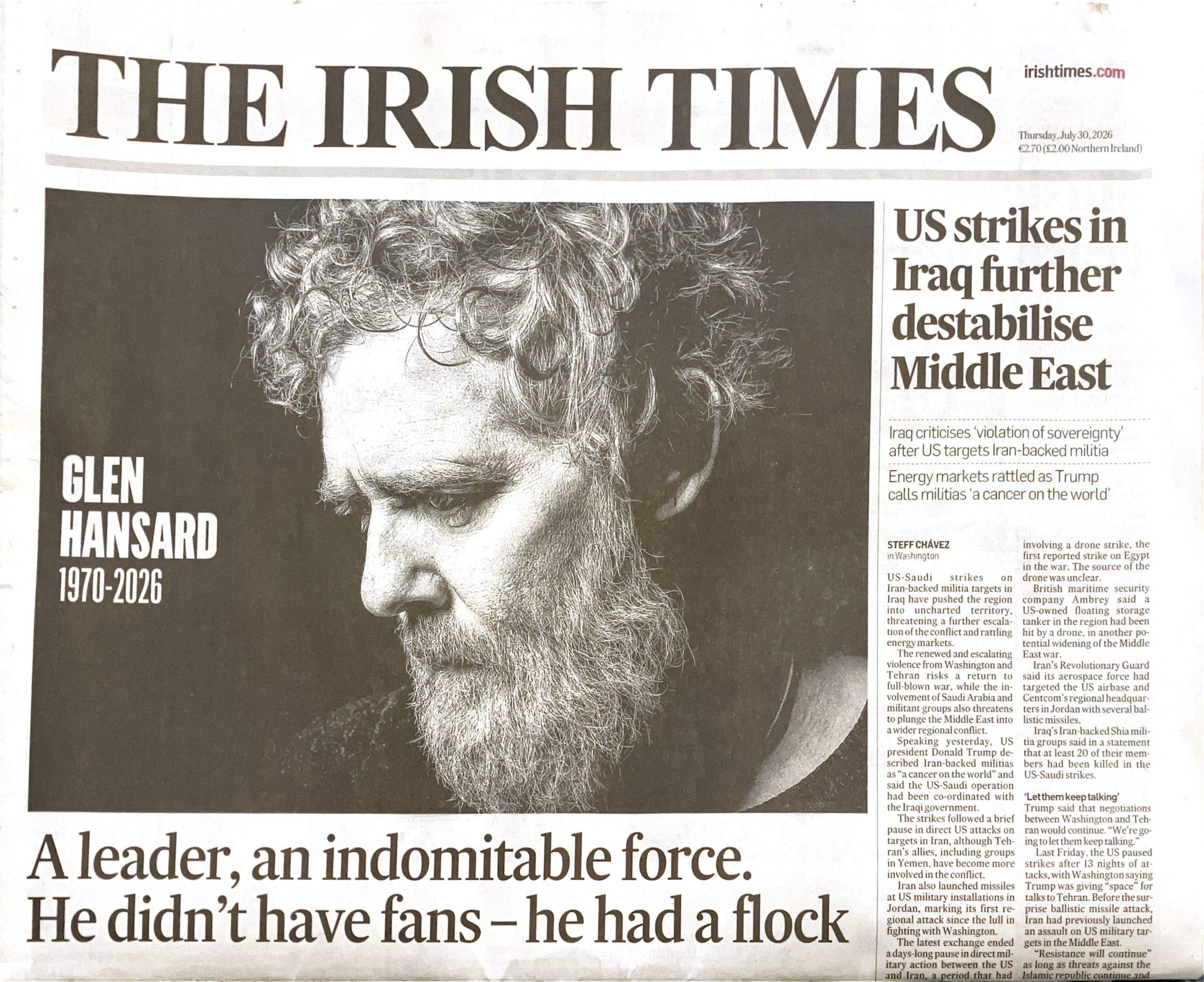
WhatsApp pinged. ‘Glen Hansard’s dead’, someone wrote.

Over the next couple of hours, a couple of group chats with university friends kept pinging away. A bunch of people from the same era, all gig-goers or musicians, swapping disbelief and stories.

When we went off on holiday for a few weeks, I took a break from writing these little self-serving posts, with the remaining list mapped out. It was going to end with what I think of as the GHEU – the Glen Hansard Extended Universe – because Hansard sat at the nexus of the group of Irish and Northern Irish musicians who heavily inspired me as a young, twenty-something songwriter. And then this happened, and it’s time to jump ahead a little.

I was too young to get the Frames in the late ’90s; my introduction came through the gift of copies of their back catalogue as a student (can you imagine, kids, you actually had to copy a physical CD to share something you’d heard with someone else.)1 I’d heard Fake on the radio, but that was probably all I was really aware of. The album that stuck the most was Dance the Devil, and it picking a single track for this list feels like grabbing something at random – but we’ll go for The Stars Are Underground. In fact, the live version of this song on Set List is probably the definitive version: these are songs to be howled en masse, not polished in a studio.

The Frames have a lot of tracks that betray the influence of grunge and bands like the Pixies, and this one is up there.

Thousands, possibly millions of words have been written this week, and I’ve nothing much of use to add to them. I first saw the Frames in those student days, but it was another record that probably, genuinely, changed my life a little. June 2006, I was living up in Belfast, staying in the chaplaincy houses on my own as I worked the floor of a local hotel in the evenings. It wasn’t a great summer; I got my driving test, but otherwise was often fairly lonely.

I took myself downtown in Belfast – this was when there were still shops you could enjoy going to – and a regular haunt was Zavvi, the former Virgin Megastore. One of my classmates worked there and it was good for hanging around. I came out that day with two brilliant albums, which unusually I had bought even though they were new and not on offer. One was The Life Aquatic Studio Sessions by Seu Jorge.2 The other was, bought on a whim, The Swell Season.

I was in an alt-rock band at the time. We were alright; the songs were straightforward enough to write, and (enough) people came to (most) of the shows and bought a few CDs. But this was the kind of music that I recognised as art.3 Glen’s genius was that he wasn’t particularly shy about wanting to be on the big stages, making something of worth, something that would move people, and being recognised for it; and yet simultaneously always came across as keen to elevate others and share the limelight around. And I think that’s probably why so many other artists I admire were so bereft at his passing, because they’d been part of that.

The Swell Season encapsulates the collision between songwriting, music, and art. Even the CD sleeve was beautiful. The songs orchestrated by this four-piece band, the cello in particular filling a sonic space in between mids and deeps so warmly. Songs like Sleeping and Lies shouldn’t be missed, in between the behemoths of Falling Slowly and When Your Mind’s Made Up which became staple covers for years after.

So a tip of the hat to Glen. It was lovely to spot some of the stars out for his (decidedly secular, even though it was in the cathedral) funeral yesterday; lots of familiar faces, now all a bit older and a bit wiser, singing their songs.4 It’s proven that the Irish approach to bereavement and grief is decidedly healthy, as we grieve in community, through stories and songs, sobs and smiles. Ní maith liom do thrioblóid.

  1. This reminds me about an article on the joy of old-fashioned music piracy, which is on the list to write some evening soon. There are still stacks of cassette tapes somewhere with my spindly handwriting on them, many taped off the radio. ↩︎
  2. Which is brilliant. Just brilliant. I don’t know why I haven’t given it an entry on this list; this list is so flawed. Go now, listen to Life on Mars in Brazilian Portuguese on acoustic guitar, and then come back feeling a little better about the world. The production on that album is so clean. ↩︎
  3. I kept Glen’s Oscar acceptance speech on my iPod for years – ‘Make art! Make art!↩︎
  4. How about Eddie Vedder. Again, how is Eddie Vedder not on this list? We’ll sneak in Rise here in the footnotes. ↩︎

LLMs, AI, and the Iterative Downgrading of Humanity

Being a stickler for the old ways, I have attempted to throttle my consumption of the Internet’s overwhelmingness by retreating (somewhat) from what’s left of “social” media1 by prioritising email newsletters from a variety of trusted sources.2 A couple of months back, there was a weird week when voices seemed to converge: it was like being at a party when your school friends and your not-school-friends and your cousins are suddenly all in the same space. It feels weird. In this case, it was tech writers and faith commentators and academics from both worlds all highlighting the same thing: Pope Leo’s encyclical, Magnifica Humanitas.

It is a truth, universally acknowledged, that when it comes to twenty-first-century ethics Roman Catholic scholars are ahead of Reformed evangelicals when it comes to making arguments from natural law.3 I have only read section of the encyclical, but Leo’s no slouch. The theme which caught my attention the most was his argument, as summed up accurately in this article by Russell Moore, that the danger in the next few decades is not that so-called artificial intelligence will become too humanlike – but actually, that we, as humans, will end up too closely resembling machines.

Computer scientist Cal Newport, currently dabbling in what he calls, ‘the emerging field of digital ethics’, and writing from the perspective of a secular academic, observes the centrality of the spoken word to the Hebrew Bible – we can extend that to the Greek New Testament also, where God’s creative Word takes on human form as the Son.4 Newport writes:

‘I’ve been thinking about this recently as I grapple with some of the consequences of the generative AI revolution. Like many people, I feel a general sense of unease when holding a fluent conversation with a chatbot. I understand that this lexical fluidity is merely an illusion – the result of endless matrix multiplications, autoregressively generating one token after another – but it still creates a discomforting sense of transgression. The sacredness of speech helps explain these feelings. It also raises some deep questions. Should we be so quick to extend the role of ruach memalela to machines, allowing them, seemingly all at once, to become active participants in a ritual so defining to our experience?’

The answer is no, because the illusion is a shaky one at best. Pope Leo is not concerned about AIs becoming godlike, and I wonder if some of that is because he understands how inevitably stupid a large-language model, trained on both open and stolen data, will increasingly become?5

An extremely significant 2023 study demonstrated, in fairly easy-to-follow ways, what the researchers termed, ‘The Curse of Recursion’ – essentially, that the more LLMs like ChatGPT or Gemini are trained by swallowing what is published across the internet, the stupider they get. Why? Because increasingly, what they are processing/digesting is content written by LLMs. In fact, ultimately these mathematicians demonstrated that the models will collapse in on themselves.

Big tech, I think, being awake to this, have prioritised other sources – namely, you. Meta are the finest example, having literally built an entire closed ecosystem predicated on harvesting users own content to sell products to them, and now to sell those users to other users by using your data to train their models and spit out ‘better’ answers. Here, LLMs take an even darker turn – the consequences of accepting that, when using any ‘AI’ tool, you are also feeding your own data and the outcomes of your engagement back into the machine to ‘improve’ it.

Moreover, as Pope Leo observes, in doing so we begin to tailor our own behaviour to the machine, and not the other way around. About fifteen years ago, I would have prided myself on my Google skills. Part of my role was effectively as a researcher, and I spent a lot of time utilising operators and particular commands to find what I needed. Search engines work best when you have figured out how to phrase your request, or to use particular operators, tags, or search terms, in order to frame your request to the way it ‘thinks’ – i.e., how it organises the data it holds. So, the way I ‘spoke’ to Google Search was adapted in order to best ‘relate’ to the machine.

This type of adaptation is not only amplified, but dramatically accelerated by ‘AI’ search. One study last October found that half of US adults were now starting with AI tools – presumably dominated by Gemini and Chat-GPT – for online searches. Ironically, some of that appears to be driven by how much worse the ‘old-fashioned’ search experience has been made by the attempt to prioritise both commercial interests and AI-generated results into search. Once again, the prophetic words of Ian Malcolm are never far from the surface.6

This week, I am grappling with a sermon on Amos 8: not a regularly-preached passage of the minor prophets. The Christian God levels at his chosen people, the historic kingdom of Israel, a repeated accusation: their false religion is exemplified by their disregard of the poor and needy in their society. These people proclaim great virtue and prosperity, whilst simultaneously they ‘trample the needy and do away with the poor of the land’ (Amos 8:4).

It struck me, as I read of how the morally bankrupt Hebrew elites are found guilty by YHWH of ‘buying the poor with silver and the needy for the pair of sandals’ – probably a reference to the practice of indentured slavery – that Pope Leo’s fears also capture a picture of people being bought and sold for profit – and how most of us seem fairly unbothered by this. TV producer and author Richard Osman recently commented that the time each of us spend using social media – on average in the UK, six hours a day – is our real contribution to the economy.7 It’s hard to dispute – social media platforms generated an estimated £11,500,000,000 for the UK economy last year from advertising alone.

But we don’t care: not because we’re particularly entertained, or inspired, but generally because it passes the time. We don’t care because we get answers slightly quicker, and they might be correct. We don’t care because we have been conformed enough to the machines to buy the lie that this, somehow, is progress.8

There’s no great conspiracy here; there rarely is. It’s just simple economics, which often trumps ethics and religion just about every time.9 It is not, ultimately, that the machines will somehow rise up and destroy us – it is, rather, that we will buy and sell ourselves into destruction, all the while calling it ‘better’. 10

Call me a Luddite – but there must be something more.
  1. “social” in quote marks. We could choose to think the best of Web 2.0 and think that the success of the earlier forms of the most popular sites/apps was due to the genuine ability to interact. Of course, when any of us open a newsfeed on the main players now, they are (a) full of posts and accounts I don’t know but are vaguely related to a thing we once watched for thirty seconds; (b) contain few posts from people I know well, because people I know well don’t post; and (c) all look the same. ↩︎
  2. This is, in its own way, an illustration of the echo-chamber problem which dominates the siloed, paywalled, modern Web. Which is a fair criticism, except this silo primarily contains people I like and respect, so I don’t care. ↩︎
  3. Perhaps ignited near half a century ago by something like Alasdair MacIntyre’s After Virtue. ↩︎
  4. John 1:14 – ‘The Word became flesh and made his dwelling among us…’ ↩︎
  5. And increasingly will serve that information up as truth. I had an ‘argument’ with ChatGPT a few months ago. ‘Where did this John Owen quote come from?’ ‘It came from [here].’ ‘I’ve looked, that source does not exist.’ ‘Of course, you are correct. It is actually [here].’ I don’t think that’s true.’ ‘You are correct. It is actually a synthesis of several sentences in…’ And so on. Most users would, I suspect, have not moved past the first step. ↩︎
  6. Your scientists were so preoccupied with whether or not they could they didn’t stop to think if they should.’ ↩︎
  7. The whole section on smart glasses (which are absolutely terrifying on very many levels) in that particular episode of The Rest is Entertainment does a good job of summing up how degrading the notion of you-as-a-product is; and how much the people harvesting your data for dollars really don’t care. ↩︎
  8. But also, you know, take a break every now and again to buy sportswear you don’t need for things you won’t do, and go outside and touch grass. ↩︎
  9. ‘”When will the New Moon be over, that we may sell grain, and the Sabbath be ended that we may market wheat?” – skimping on the measure, boosting the price and cheating with dishonest scales, buying the the poor with silver and the needy for a pair of sandals, selling even the sweepings with the wheat. The LORD has sworn by himself, the Pride of Jacob: “I will never forget anything they have done.”‘ (Amos 8:5–7). ↩︎
  10. ‘They exchanged the truth about God for a lie, and worshipped created things rather than the Creator…’ (Romans 1:25) ↩︎

Men, and Singing in Church

A small but consistent feature of our childhood was church on a Sunday morning; a small Anglican congregation in a rural village, not so much bucolic as simple and straightforward. My father, bless him, brought up a Presbyterian-by-rote, took to his first wife’s Anglicanism like a duck to water, and took attendance seriously. Moreover, and to his credit, he always did his best when it came to singing – and its something I remember very clearly.

It’s notable to me because, subsequently spending many years leading congregations in praise and music, I’m very conscious that male singing is often missing. As a football fan, I’m convinced singing itself is not the problem – all men are capable of making a noise, and with practice – I mean, by doing it, not even necessarily by training – just about anyone can hold a tune.

Writing in Christianity Today, Kelsey Kramer McGinnis correctly observes that this is partly an issue of musical tone – not just the key, but the whole tenor of modern praise and worship is geared towards higher and clearer male voices, and not the fuller baritone which most men possess. As someone with a fairly high tenor in my teens and early 20s, this suited me down to the ground; but as I’ve reached middle age and dropped a couple of tones, selfishly I too now find it increasingly difficult to sing newer songs with higher ranges, compared to the tried-and-tested settings of older hymnody. It remains surprisingly to hear modern worship in a deeper register – its why someone like Jordan Kauflin at Sovereign Grace, for example, sounds so unusual.

The other issue, as well documented, is the ’90s–’00s proliferation of…. softer? lyrical content. We tread carefully here: one of the reasons behind the rapid rise of the toxic subset of new Calvinism, particularly in the US, twenty years ago was that it was pitched as an attempt to reclaim a more masculine Christianity, and the language and outcomes of such false teaching have been incredibly damaging. Nevertheless, I suspect one of the reasons that songs with more hymn-like language, along with bone fide psalm-singing, are currently increasingly popular (again)1 in my own Irish Presbyterian tradition is because men feel more comfortable declaring biblical truths in less poppy words.

When visiting our church last November, Ligon Duncan made the claim that the only [Protestant] denomination in the United States which was experiencing growth was the more conservative Presbyterian Church in America (PCA). Why? One for the reasons, he said, is ‘in this kind of a culture, you better have a big God, with big truths, to be able to speak into this despair and discouragement that exists.’

So too, I think, with singing. As someone who spends a lot of the time standing at the front, looking out across rooms of people singing, I’m convinced that men feel most encouraged to sing when the musicians meet them in the middle with hymns and songs that (a) are pitched musically at an appropriate register, but also (b) with content that declares a big God with big truths.

As more and more men begin to trickle back to church, particularly amongst young adults, it is incumbent upon those who write, those who play, and those who lead to encourage the whole body of the church to sing. And it is incumbent upon men, fathers, brothers, uncles, grandfathers, to sing. Singing teaches truth which people remember for life. Singing unites heart and mind. Singing unites us together. God sang. You should try too.2

  1. Because, of course, this has all happened before: for example, the rise of ‘revival’ hymns and more emotional language in the late nineteenth century in the West, before a swing back to more traditional evangelical hymns in the mid-twentieth century, before the seeker-sensitive movement of the ’80s-’90s, before the CCM-heavy output of the end of the century, and so on. Back and forth. ↩︎
  2. And remember: even if you’re worried about how you sound, don’t be. No-one’s listening to you – they’re too busy worrying about how they sound themselves. ↩︎

40×40 // 26 – Awkward Annie (2007)

The start of summer. There was a time in life this meant the start of ‘summer teams’ season; packing off to a church hall somewhere for a week, or to summer camp, ready to run clubs for kids and teenagers. That slowly became festival season: first as a photographer; then as a production dogsbody on the A/V side; then, later, as an occasional venue manager, risk assessment in hand. All these things meant teamwork, regular all-nighters, too much coffee, and just trying to stay on top.

In between duties, you might have often found me tucked away behind a stage somewhere, earphones in, breathing deeply and trying not to unload on whoever had sinned against my planning. As a result, I completely associate these moments in life with a seesaw mix of soothing alternative folk and rock bangers.1

Kate Rusby’s album Awkward Annie epitomises the former – plenty of breathing space on an album of little episodic stories, best known for the lead single Planets but full of just enough lament to calm a racing mind down.2 A folk singer so talented, she should have been Irish.

  1. For example, summer means: I’d Rather Be With You and Better Together, but it also means The Ataris top class cover of Boys of Summer. ↩︎
  2. A special mention for the album recording of High on a Hill, featuring Chris Thile – one of the few mandolin riffs simple enough that even I can play it. ↩︎

40×40 // 25 – The Night Song (2021)

This particular day is a slightly unusual one. Tonight, my colleague Karen and I are due to be licensed as ‘probationers for the Christian ministry’ – aka, we’ve just completed three brilliant years of formal training at Union Theological College, alongside placement in various churches,1 and now are accredited in our home church to go and serve in our new one as assistants.

This month has been full of them, and we’re the last out of the gate. It’s also a little unusual (these days) because both of us have come from the same church, where we were (at the moment of writing, still technically are) elders, so double the fun.

Like most of the services of this kind, it is mostly other people doing things: except in the middle, where we are licensed – we come up and answer a series of questions publicly to affirm we understand and commit to our profession of faith and working within the Presbyterian system. This week – even though I’ve heard them several times recently – I was looking back over the questions we will be asked,2 and I stuck a little on the second one:

‘So far as you know in your own heart, have you been induced to seek the office of ministry from love to God and from a sincere desire to win souls to Christ and to promote God’s glory?’

I paused a little to examine myself. Is this the reason I have gone through all this? Or could it be for less altruistic reasons? Job security? A certain type of status? The opportunity to badger a captive audience? And so on…

One of the motivators in my life to ultimately pursue ministry was the slow, dawning realisation that, like most professions, those whose serve the church as pastors and teachers do not (or should not) feel any more like an expert than the rest of us. Each are talented in different ways. Some are great explainers of things. Others are talented personal evangelists. Some are natural entertainers. Others are more cerebral. And actually, within a local presbytery – group of ministers and elders – it is most useful to have a healthy range of these things.

During weeks like this one, where I have felt fairly inadequate, this is always an encouragement.

The Night Song is a lesser known collaboration between CityAlight and legendary (in a particular niche!) singer-songwriter, Colin Buchanan. The first time I tried playing it through for our littlest kids, it completely threw me emotionally, but we soldiered on. It is a quiet little song, a lullaby really, but psalmic in its lyricism as it reminds us that God will keep us, no matter the circumstances.

For the first few years of parenthood, I always felt a little silly singing to our kids, despite (as long-term readers will know) taking far too much pride in my relatively short and completely insignificant time as a gigging musician. Yet once I got over the hump, it is a great source of learning and of enjoyment. Little songs like this allow even someone who feels shy about it – like me – to teach some simple truths that people might carry for the rest of their lives. Because they so often do.

On occasions, when I have been privileged to sit beside someone coming towards the end of their life in a care setting, these types of songs are the ones that come to mind. People do not often find comfort singing elaborate worship pieces. They sing, Jesus loves me, this I know. They sing, The Lord is my shepherd. I suspect, in a few decades, some may sing, Jesus says when I am lost, I should come to him or maybe even something like The Night Song. And it is a most holy thing to be with them, and even to join in, when they do.

So I will attempt to sincerely answer the question above, as worded, when we are licensed later, with memories like this in mind. Of sitting beside our youngest, tapping away on the piano and singing to her that God will hold her through the night. Of sitting beside an older person as she began whispering to herself, I to the hills will lift mine eyes. Of preparing to speak this Sunday evening on the gift of faith, freely given, to all who will place their trust in something outside of themselves. Does this qualify as winning souls and promoting God’s glory? Perhaps it does – one quiet, holy moment at a time.3

  1. Shoutout to the heroes of First Dromara, Ballysillian, Dundonald, and our current home at Hill Street. ↩︎
  2. Paragraph 291.1.3 if you’re interested! ↩︎
  3. 1 Kings 19:11–13 (NIV) – The Lord said, “Go out and stand on the mountain in the presence of the Lord, for the Lord is about to pass by.” Then a great and powerful wind tore the mountains apart and shattered the rocks before the Lord, but the Lord was not in the wind. After the wind there was an earthquake, but the Lord was not in the earthquake. After the earthquake came a fire, but the Lord was not in the fire. And after the fire came a gentle whisper. When Elijah heard it, he pulled his cloak over his face and went out and stood at the mouth of the cave. Then a voice said to him, “What are you doing here, Elijah?” ↩︎

40×40 // 24 – The Stars Over Kinvara (2021)

Probably around 2005 or so, a uni housemate lent me Songs from a Room 2, the second CD compilation from the RTE series Other Voices. Other Voices walked so that things like NPR’s Tiny Desk Concerts could run, honestly. Glen Hansard presented the first series. That second album had a number of artists I ended up trying to see live, and some songs that stayed with me a long time: the electrifying Your World by Declan O’Rourke being one of them.

Years later, and with Father’s Day looming this weekend, I’m minded of another of Declan O’Rourke’s songs: the deeply moving The Stars Over Kinvara, a meditation on fatherhood and the sense of reflection it instigates, and the connection it curates, upon one’s own place in time and space. The eponymous recurring line in each chorus lands perfectly.

I only discovered this week that it was produced by Paul Weller, but that fits too: it has an acoustic guitar tone you would sell your house for.