Category: August 2026

What we’re talking about when we talk about AI

Hanging out with friends last Saturday, I asked someone who manages a team in IT about something that I see the BBC have labelled ‘tokenomics’1 (hats off to that subeditor) – how on earth one begins to measure the value of the tokens which companies of all stripes are now budgeting for their employees’ use of AI agents. In his role, he get 300 tokens a day, and every now and again he maxes that. But, as the BBC explain well, there’s no real way to anticipate how many tokens a particular task is going to consume, so budgeting your daily work is tricky at best.

I continue to have a stack of AI-related articles accumulating in my inbox – as you may well also, if you have subscribed to really anything at all in 2026.

I have The Gospel Coalition telling me they’re banning the use of AI in writing articles submitted for publication2 – a line many publications are drawing, though most won’t publish a whole manifesto to that end.

I have Cal Newport gently dismantling the recent publicity-generating stunts around AI agents ‘escaping’ from their sandboxes – an actual expert pouring quite a lot of water on the fire, whilst also drawing attention to some real onrushing issues.3

I have Jon Gruber highlighting this excellent and revealing essay by Nikhil Suresh, where Suresh details what many thinking people suspect – even if big businesses have no use for AI in a particular area, they’re shoehorning it into every possible nook or cranny, because their clients assume it represents some kind of whiggish progress – a sort of, ’10x EVERYTHING’ mentality, even if we’re already seeing some evidence that adding AI agents does not streamline work – it just changes it to new work.4

And I have (via Jason Kottke), David Reichert’s deep dive into a distinction I think we’re struggling to delineate right now, but which is rapidly developing – the gap between what most people think of as AI – which are really free bits of software we can use to generate language responses or images, or even video clips – and the hugely powerful agents which have already transformed programming in business.5

How do we reflect on all this? Well for one thing, it strikes me we need our descriptors to evolve, and some new nouns to be added.

I’ve spoken a lot, and written a little, about the limitations of LLMs, but nevertheless Joe Public will continue to call ChatGPT or Gemini ‘AI’. But if you speak to a coder, they’re using the term to refer to hugely powerful models that they are spending their days speaking to through terminals and deploying for work purposes.

A little randomly, I was on GitHub the other day, looking at the account of someone I know, and noticed that in the last year his daily commits across a range of projects (he leads a design company) have gone from a handful to dozens a day. But of course they have: he’s now able to deploy models to write, test, and iteratively improve what he’s working on at a pace we could only dream of in the days of tapping out every line of code by hand.

We need new names for the models consumers are using, versus the actual revolution that’s happening in the backend of software. I don’t much trust either, although they absolutely have their uses – but I wouldn’t mind the language to talk about them more clearly.

  1. Joe Fay, ‘Tokenomics: Why making AI pay is tricky‘, BBC News, 12 August 2026. ↩︎
  2. Brett McCracken, ‘Our Line in the Sand on AI: TGC’s Missional Opportunity‘, The Gospel Coalition, 5 August 2026. ↩︎
  3. Cal Newport, ‘Did OpenAI’s New Model “Go Rogue”?‘, CalNewport.com, 27 July 2026. ↩︎
  4. Jon Gruber, ‘AI Mania is Eviscerating Global Decision-Making‘, Daring Fireball, 25 July 2026. See also: Slack; email; every other transformative technology that just ended up generating more administration and less deep work. ↩︎
  5. David P. Reichert, ‘If you haven’t recently used Claude Code, you might not understand where AI is at‘, Substack [Yuck], 3 August 2026. ↩︎

40×40 // 28 – One of Us (1995)

ChatGPT has just reminded me1 that a large part of my musical input is what is loosely labelled ‘Adult Alternative Pop Rock’. To be fair, the AllMusic description has me nailed to a post. Well, let’s lean into it.

I was probably at youth fellowship a decade too late for the Christian ire against Joan Osborne’s seminal 1995 single, One of Us, but as a piece of pop – sorry, adult alternative pop/rock – in my mind it bookends a whole category of North American female singer-songwriters who crossed over into radio-friendly pop rock, with similar production sounds – from the jangly rock stuff to the big-but-compressed drum tracks.2 The first iteration is people like Alanis Morissette, Osborne, Sarah McLachlan, Fiona Apple, Paula Cole, Shawn Colvin.3 Can we include Lisa Loeb? Let’s.4

The second round come five years or so later: Michelle Branch, Vanessa Carlton, Sara Bareilles. You get the idea. There’s alt-rock on one side. There’s bubblegum pop on the other. Somewhere in between, but tending towards the former (thankfully), are four-minute, crafted wonders.

Crafted is an important word here. It’s easy to dismiss pop music. Pop music is incredibly difficult to do well. I had a humble go at song-writing for years; I wrote a few genres, but pop is too hard. These pop-rock records go through iteration after iteration to nail the hook and hone the lyrics. (If you’ve twenty minutes at some point, the Vice doc on Vanessa Carlton’s journey with 1000 Miles makes the case well. She clearly ended up feeling it wasn’t quite her song any more, yet it still means so much.)

So, back to Joan Osborne.

There a lazy, cultural Christian response5 to this song which I don’t think sincere believers should give too much weight. We might even point out: well, God did become one of us. That’s sort of the central pivot of not just the Bible, but time itself.

However, the songwriters argue the song isn’t about God at all: it’s about us. Co-writer Eric Bazilian:

‘The key line is: “What would you ask if you just had one question?” But my first impression was that it wasn’t about God. It was about what would happen if you saw something that blew your worldview out of the water.’

I’m not sure that arguing this extreme really holds up either, though I’ll accept the lyric certainly is one of confrontation. It’s just that, plainly reading it, it seems to be being confronted by God:

‘If God had a face, what would it look like / and would you want to see, if seeing meant that you would / have to believe, in things like heaven / and in Jesus, and the saints, and all the prophets…’

The 2020s aren’t the 1990s; nevertheless, I remarked in a sermon last night that our everyday cultural dialogue remains saturated with the language of faith, and the Christian faith in particular. Setting aside any kind of pseudo-theology, this lyric does asks us: what would it be like if we were confronted by God in the flesh? What would we do with it?

Well, I am no expert apologist or theologian: but every time I hear this slice of music history, I am continually moved to think: he did have a face. He poured himself into a form that meant we could see, we had to believe, and nothing about our interior or exterior lives can really stay the same. Of course he wasn’t just like us: he was the best of us; made incarnate, the God of names and faces, of slobs and buses, of strangers and friends, of pastors and popes – the God who made and governs all of it took on cells and blood and membrane6 in order to show us what a completely fulfilled human life actually looks like: one of community, one of suffering, then one of everlasting triumph. and the free and open invitation to be part of it forever.

It is so blatantly obvious that even (checks notes) adult alternative pop-rock cannot help but be touched by it from time to time.

  1. To riff on a famous label from a century ago; eyeball-gnawing statements like this might, I think, lead to us thinking of this decade as the Boring ’20s. As in: this is peak humanity? Relying on LLMs to tell us things we’ve forgotten? We’re so dull. Yet here we are. ↩︎
  2. They’re all songs you could swear are on a volume of Songs from Dawson’s Creek. And to be fair, several of them are. ↩︎
  3. Sonny Came Home. No notes. It’s not getting an entry but it could have been the headliner for this article. ↩︎
  4. That woman’s punked-up cover of her own song alongside New Found Glory is fabulous. Her voice is absolutely ageless, all credit to her. ↩︎
  5. cf. Harry Potter. I remember the petitions being passed around at school. Thank goodness the same completely sincere but unfortunately misguided people clearly weren’t aware of Tolkien and Lewis. ↩︎
  6. John 1:14. ↩︎

40×40 // 27 – The Stars Are Underground (1999)

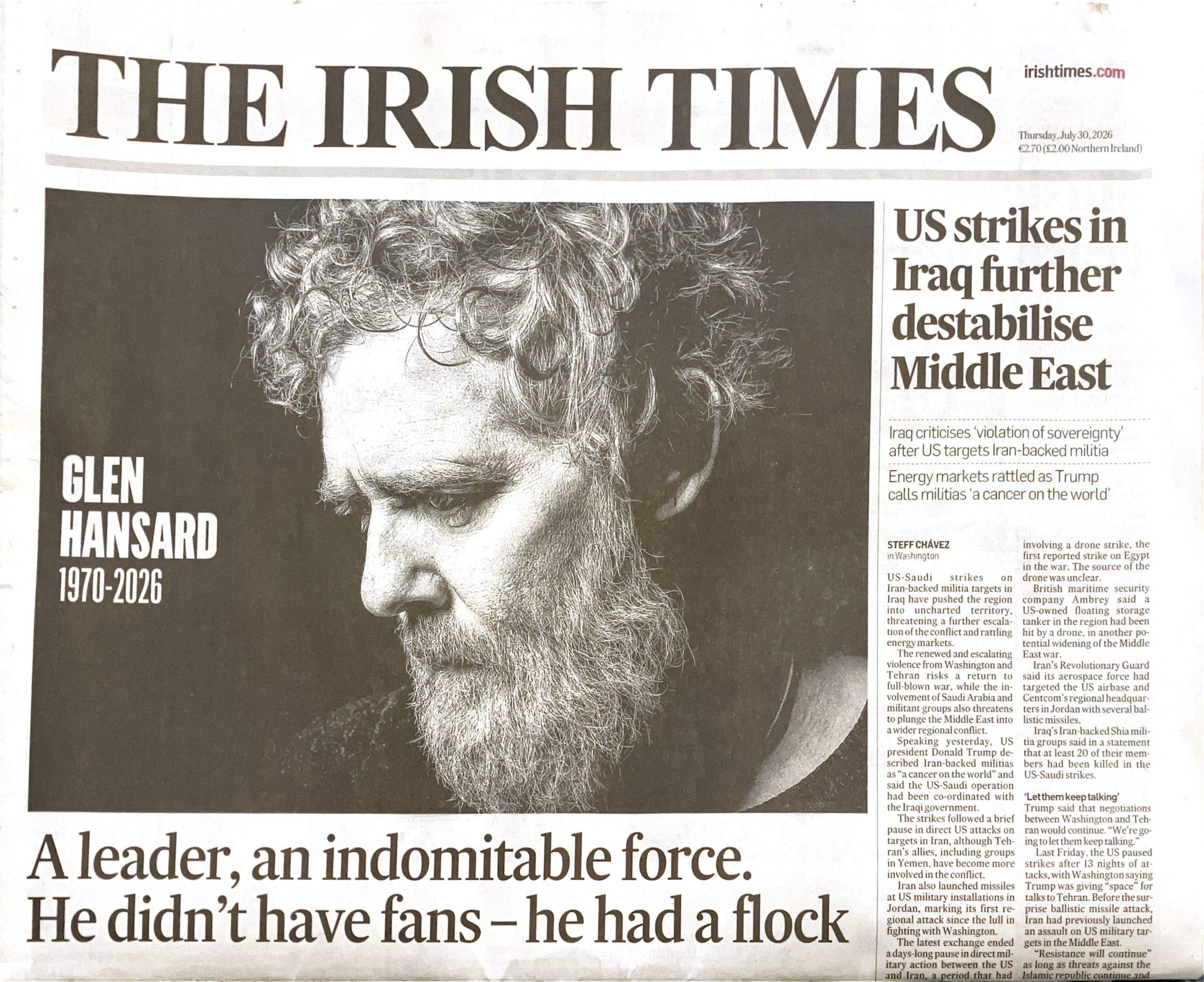
WhatsApp pinged. ‘Glen Hansard’s dead’, someone wrote.

Over the next couple of hours, a couple of group chats with university friends kept pinging away. A bunch of people from the same era, all gig-goers or musicians, swapping disbelief and stories.

When we went off on holiday for a few weeks, I took a break from writing these little self-serving posts, with the remaining list mapped out. It was going to end with what I think of as the GHEU – the Glen Hansard Extended Universe – because Hansard sat at the nexus of the group of Irish and Northern Irish musicians who heavily inspired me as a young, twenty-something songwriter. And then this happened, and it’s time to jump ahead a little.

I was too young to get the Frames in the late ’90s; my introduction came through the gift of copies of their back catalogue as a student (can you imagine, kids, you actually had to copy a physical CD to share something you’d heard with someone else.)1 I’d heard Fake on the radio, but that was probably all I was really aware of. The album that stuck the most was Dance the Devil, and it picking a single track for this list feels like grabbing something at random – but we’ll go for The Stars Are Underground. In fact, the live version of this song on Set List is probably the definitive version: these are songs to be howled en masse, not polished in a studio.

The Frames have a lot of tracks that betray the influence of grunge and bands like the Pixies, and this one is up there.

Thousands, possibly millions of words have been written this week, and I’ve nothing much of use to add to them. I first saw the Frames in those student days, but it was another record that probably, genuinely, changed my life a little. June 2006, I was living up in Belfast, staying in the chaplaincy houses on my own as I worked the floor of a local hotel in the evenings. It wasn’t a great summer; I got my driving test, but otherwise was often fairly lonely.

I took myself downtown in Belfast – this was when there were still shops you could enjoy going to – and a regular haunt was Zavvi, the former Virgin Megastore. One of my classmates worked there and it was good for hanging around. I came out that day with two brilliant albums, which unusually I had bought even though they were new and not on offer. One was The Life Aquatic Studio Sessions by Seu Jorge.2 The other was, bought on a whim, The Swell Season.

I was in an alt-rock band at the time. We were alright; the songs were straightforward enough to write, and (enough) people came to (most) of the shows and bought a few CDs. But this was the kind of music that I recognised as art.3 Glen’s genius was that he wasn’t particularly shy about wanting to be on the big stages, making something of worth, something that would move people, and being recognised for it; and yet simultaneously always came across as keen to elevate others and share the limelight around. And I think that’s probably why so many other artists I admire were so bereft at his passing, because they’d been part of that.

The Swell Season encapsulates the collision between songwriting, music, and art. Even the CD sleeve was beautiful. The songs orchestrated by this four-piece band, the cello in particular filling a sonic space in between mids and deeps so warmly. Songs like Sleeping and Lies shouldn’t be missed, in between the behemoths of Falling Slowly and When Your Mind’s Made Up which became staple covers for years after.

So a tip of the hat to Glen. It was lovely to spot some of the stars out for his (decidedly secular, even though it was in the cathedral) funeral yesterday; lots of familiar faces, now all a bit older and a bit wiser, singing their songs.4 It’s proven that the Irish approach to bereavement and grief is decidedly healthy, as we grieve in community, through stories and songs, sobs and smiles. Ní maith liom do thrioblóid.

  1. This reminds me about an article on the joy of old-fashioned music piracy, which is on the list to write some evening soon. There are still stacks of cassette tapes somewhere with my spindly handwriting on them, many taped off the radio. ↩︎
  2. Which is brilliant. Just brilliant. I don’t know why I haven’t given it an entry on this list; this list is so flawed. Go now, listen to Life on Mars in Brazilian Portuguese on acoustic guitar, and then come back feeling a little better about the world. The production on that album is so clean. ↩︎
  3. I kept Glen’s Oscar acceptance speech on my iPod for years – ‘Make art! Make art!↩︎
  4. How about Eddie Vedder. Again, how is Eddie Vedder not on this list? We’ll sneak in Rise here in the footnotes. ↩︎