Category: 40×40

  • 40×40 // 05 – How He Loves (2005)

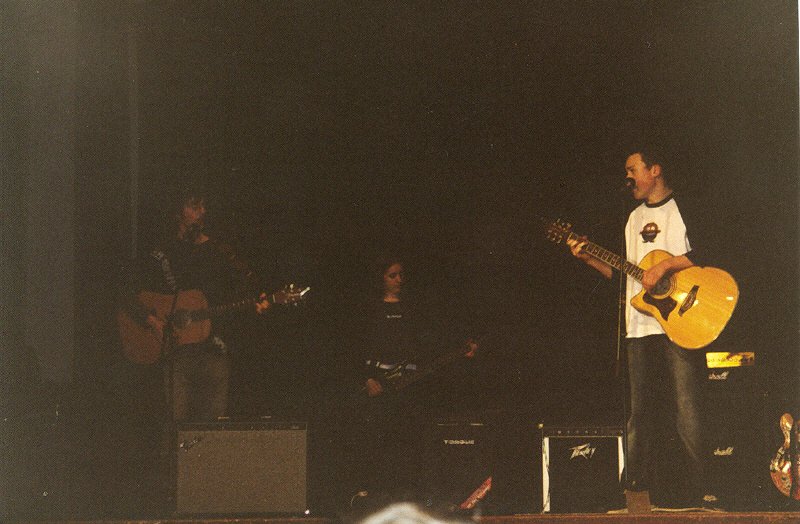
    Sometime, maybe around 2009, I was sitting awkwardly at a low-key concert (some kind of coffee bar style thing), when a musician friend, Andrew, ambled over.1 He’d been in the States for a year with his bandmate Steven,2 and had come back with a bunch of war stories which I enjoyed hearing. And he mentioned that Steven’s brother-in-law was this up-and-coming singer-songwriter who, in Andrew’s opinion, was the real deal.

    A while later, I remember driving to work on a Sunday morning with the iPod hooked up to the car stereo, and a song I didn’t know came on from some freebie sampler collection (remember those?). And I sat in the car until the song had finished, and played it again. And again on the way home. I found the CD sampler, which had embedded video files (again, remember those?), so stuck it in the computer. And when I watched the video – there was a glimpse of Andrew, bouncing around in his blue T-shirt in the background – and I realised, ‘Oh: this is the guy?’

    ‘The guy’ was John Mark McMillan; the song, ‘How He Loves’; and in my opinion, the rulebook for contemporary praise and worship, such as it was, had been torn up forever.

    In my lifetime, contemporary praise – aka What We Sing At All The Things – had rapidly evolved from Graham Kendrick and friends, through to the rock orientated – but less geared for corporate singing – more acceptable end of American CCM music. I enjoyed seeing both Third Day and particularly David Crowder Band in that period; but even at by the early 2000s, the emergence of the behemoth Hillsong Music was shifting things up to a level of slickness that would lead to a backlash.

    John Mark McMillan is not contemporary Christian music by any stretch – rather, like the Switchfoots of this world, a musician who writes about what matters to him, and what matters to him are often big questions about faith. But his talent is in mining a vocabulary that puts into the air words that sound real – not the limited range of the corporate Christian machine, but like the best poetry, words that paint a portrait of a heart and mind processing life in the presence of an infinite king.

    The hunger of such music drew a line, however indirectly, to the explosion in stuff like Housefires a decade later3 – which of course, then led to the machine taking a turn, like so much of our culture, to more ‘authentic’ sounds in praise and worship. But throughout his body of work,4 McMillan has continued to innovate and find words to express meaning for his journey, and it is always heartening to me to go back and hear a range of songs that sound like a man crying out, in praise, exploration, or grief5 – or, like life, very often a mixture of all these things – and very many other voices joining in.

    1. Andrew’s got a good back catalogue, both as a band leader and a solo artist, but a personal favourite is this soaring performance with the Ulster Orchestra, reworking a track from his eponymous album. ↩︎
    2. The genius multi-instrumentalist, Mr Stephen Williams, of Sons of Caliber, Jude Moses, and of course – John Mark McMillan. ↩︎
    3. These days, this kind of ↩︎
    4. Let’s pick a few: Death in Reverse (2018); Borderland (2014); and Death in His Grave (2010) are three great tracks from three great albums, but there are many more. ↩︎
    5. How He Loves has a significant back story, stemming from a tragic accident, and leading to a difficult third verse which McMillan rarely performed live as the years went on. But the story, as he tells it in this song story video, is beautiful. ↩︎

  • 40×40 // 03 – The World Ain’t Slowin’ Down (1998)

    Whilst about to begin a different anecdote about this song, a mild episode of PTSD has occurred – a flashback to a moment in the 2000s. Whilst still at school, a makeshift band were asked to perform a couple of songs at a fundraiser (a fashion show, no less, to which I inexplicably thought it would be a good idea to wear a cartoon t-shirt I had designed myself1). I believe the two songs we performed were Ironic and this: an obscure album track by folk revivalist Ellis Paul, given prominence by its appearance over the end credits of Jim Carey’s slapstick Me, Myself & Irene. In my caffeine-fuelled flashback, the room was stonily silent throughout: not for the first or last time!

    When I first heard this song, during a late night movie-binge at my cousins, during the summer break of 2001 or 2002, it was one of those things where you had to scroll through the credits and write it down, then play on repeat off the VHS or DVD itself.2 Kids, in an era before streaming, it was probably then off to acquire it online from an (cough) alternative source, and then work out how to play it by ear.

    We’ve previously mentioned how musical tastes supposedly skew towards your teenage years – and I think that largely holds up – but a caveat to my own is I think my tastes skew towards the things I was watching in my teenage years, which, with TV and movies in view, often means retrieving things from the late ’90s and earlier 2000s.3 The impact of such music was profound – alongside the love of film that I contracted over those summers, hanging out and making terrible short films, the two would combine and lead towards setting out to study Film and Music together at university a couple of years later.

    Ellis Paul has a couple of other great tracks of note – Sweet Mistakes is a clever piece of writing, which also had fifteen minutes of fame on the soundtrack of another Farrelly Brothers’ film, Shallow Hal – but the innocent soul of this song, with a simple riff that even a clumsy teenager can handle, kept it a go-to song in my mind’s catalogue for many years.

    1. Alright, here’s proof. ↩︎
    2. Other imprinted tracks from this period: Aerials, Californication, and Frontier Psychiatrist. ↩︎
    3. We’ve previously mentioned the golden era of official soundtracks. ↩︎
  • 40×40 // 01 – Gifts and Curses (2004)

    40×40 is a forty-week project, recapping forty tracks from the last forty years in no particular order to tell a few stories. The whole lot – plus many, many footnoted extras – are available on this Spotify Playlist (unless, like this week’s, they’re not!)

    So-called ‘lost media’ has been a bugbear for many, many years (and a reason I still, like a broken record, regularly cite Jeremy Keith’s 2011 talk All Our Yesterdays to anyone who will listen).1 I imagine the TV show Ed will crop up in a later entry in this series, a peak example of the medium – a show essentially kept off streaming because of the huge headache of transferring rights to a broadcast medium no-one envisioned when playlisting a whole host of great indie artists for the soundtrack.

    Stuck in such hell are a great many film soundtracks of the early digital era, amongst them 2004’s Spider-Man 2 – which contains a handful of great, unique tracks,2 foremost of which is Yellowcard’s Gifts and Curses.3

    Some say the music you are listening to in your later teens will be the music you carry through life: I was 18 when I got this OST CD, at peak pop-rock-transitioning-to-shoegaze, and Yellowcard were absolutely one of the bands regularly appearing on Kerrang! or MTV2 or whatever it was I was turning up and trying to play along with on the telly. But soundtrack albums are not where people’s best work end up: soundtrack albums are supposed to have a couple of big singles, and the rest is typically filler. There are exceptions, of course. But that this band chose to pour a significant amount of talent and creativity into a mid-track that, and this is crucial, really is actually based on and/or inspired by Spider-Man 2, is just fantastic. Production is razor-sharp; the mix is brilliant, with soaring violin; and the breakdown, though perhaps overindulgent, fits the product description as a soundtrack track. I believe it’s a fan favourite; and that, and only that, has saved it from the mists of time.

    Yellowcard had hits before and long after this,4 but I’m not sure it ever got better.

    1. Ironically, this series of films, which I had the privilege of directing and editing when working for Box42, almost became lost media themselves when they came off Vimeo a few years ago – at the time, the most well-known, When we Build by Wilson Miner, was at something like three million impressions – all gone. ↩︎
    2. I’m in big trouble with at least one other person on the planet for relegating Dashboard Confessional’s Vindicated to a footnote, but it appears on another record so it doesn’t count. ↩︎
    3. Sadly, I suspect the presence of a track from LostProphets means no-one’s campaigning for this compilation to be re-released. ↩︎
    4. The pick of the bunch is probably Ocean Avenue (with an incredible drum pop at 2:42), but as recently as late last year they put out You Broke Me Too, a great throwback featuring Avril Lavigne – which about twenty years ago would’ve definitely been worthy of blanket coverage on TRL or similar. ↩︎
  • 40×40 // 00 – Pregap

    Without wanting to give too much away to the crawlers – 2026 brings a significant birthday. The kind of one where your doctor sees your date of birth, and swaps the checklist. There are probably blue nitrile gloves involved at some point.

    Some months ago, I was ruminating and reflecting on this, and came up with the idea of listing forty songs from my lifetime thus far: not the best songs, not the most significant, necessarily; but, as someone who has loved recorded music from an early age, songs that conjure up memories. And so, since then, I have compiled a list of songs – many, many more than forty – and am now trying to whittle it down.

    The (admittedly self-indulgent) concept will be to publish a brief note about one song a week, probably along with a few footnotes to allow me to direct your attention to other bits of ephemera (and frankly, squeeze in lots of other songs). Forty songs for forty years over forty weeks; no more, no less. There is no order, and little logic: just vibes, nostalgia, and an unhealthy bias towards ‘as featured in [US TV show]’ in the 2000s.1

    This preliminary article – the pregap,2 if you will – has no other purposes than, firstly, to explain this once, so I do not feel the need to repeat it; and secondly, to commit to the concept by throwing my cap over the wall.3

    1. Let’s just all take a moment to give thanks for Christa Miller’s work as the music supervisor on Scrubs. ↩︎
    2. The pregap is the bit on a CD before the first track, where occasionally artists would hide a track only accessible by ‘rewinding’ just the right amount from the start of track 1. My favourite: Damien Rice, 9 Crimes (demo). ↩︎
    3. A story that comes from Frank O’Connor, but best explained by Jed Bartlet. ↩︎