Category: 40×40

40×40 // 28 – One of Us (1995)

ChatGPT has just reminded me1 that a large part of my musical input is what is loosely labelled ‘Adult Alternative Pop Rock’. To be fair, the AllMusic description has me nailed to a post. Well, let’s lean into it.

I was probably at youth fellowship a decade too late for the Christian ire against Joan Osborne’s seminal 1995 single, One of Us, but as a piece of pop – sorry, adult alternative pop/rock – in my mind it bookends a whole category of North American female singer-songwriters who crossed over into radio-friendly pop rock, with similar production sounds – from the jangly rock stuff to the big-but-compressed drum tracks.2 The first iteration is people like Alanis Morissette, Osborne, Sarah McLachlan, Fiona Apple, Paula Cole, Shawn Colvin.3 Can we include Lisa Loeb? Let’s.4

The second round come five years or so later: Michelle Branch, Vanessa Carlton, Sara Bareilles. You get the idea. There’s alt-rock on one side. There’s bubblegum pop on the other. Somewhere in between, but tending towards the former (thankfully), are four-minute, crafted wonders.

Crafted is an important word here. It’s easy to dismiss pop music. Pop music is incredibly difficult to do well. I had a humble go at song-writing for years; I wrote a few genres, but pop is too hard. These pop-rock records go through iteration after iteration to nail the hook and hone the lyrics. (If you’ve twenty minutes at some point, the Vice doc on Vanessa Carlton’s journey with 1000 Miles makes the case well. She clearly ended up feeling it wasn’t quite her song any more, yet it still means so much.)

So, back to Joan Osborne.

There a lazy, cultural Christian response5 to this song which I don’t think sincere believers should give too much weight. We might even point out: well, God did become one of us. That’s sort of the central pivot of not just the Bible, but time itself.

However, the songwriters argue the song isn’t about God at all: it’s about us. Co-writer Eric Bazilian:

‘The key line is: “What would you ask if you just had one question?” But my first impression was that it wasn’t about God. It was about what would happen if you saw something that blew your worldview out of the water.’

I’m not sure that arguing this extreme really holds up either, though I’ll accept the lyric certainly is one of confrontation. It’s just that, plainly reading it, it seems to be being confronted by God:

‘If God had a face, what would it look like / and would you want to see, if seeing meant that you would / have to believe, in things like heaven / and in Jesus, and the saints, and all the prophets…’

The 2020s aren’t the 1990s; nevertheless, I remarked in a sermon last night that our everyday cultural dialogue remains saturated with the language of faith, and the Christian faith in particular. Setting aside any kind of pseudo-theology, this lyric does asks us: what would it be like if we were confronted by God in the flesh? What would we do with it?

Well, I am no expert apologist or theologian: but every time I hear this slice of music history, I am continually moved to think: he did have a face. He poured himself into a form that meant we could see, we had to believe, and nothing about our interior or exterior lives can really stay the same. Of course he wasn’t just like us: he was the best of us; made incarnate, the God of names and faces, of slobs and buses, of strangers and friends, of pastors and popes – the God who made and governs all of it took on cells and blood and membrane6 in order to show us what a completely fulfilled human life actually looks like: one of community, one of suffering, then one of everlasting triumph. and the free and open invitation to be part of it forever.

It is so blatantly obvious that even (checks notes) adult alternative pop-rock cannot help but be touched by it from time to time.

  1. To riff on a famous label from a century ago; eyeball-gnawing statements like this might, I think, lead to us thinking of this decade as the Boring ’20s. As in: this is peak humanity? Relying on LLMs to tell us things we’ve forgotten? We’re so dull. Yet here we are. ↩︎
  2. They’re all songs you could swear are on a volume of Songs from Dawson’s Creek. And to be fair, several of them are. ↩︎
  3. Sonny Came Home. No notes. It’s not getting an entry but it could have been the headliner for this article. ↩︎
  4. That woman’s punked-up cover of her own song alongside New Found Glory is fabulous. Her voice is absolutely ageless, all credit to her. ↩︎
  5. cf. Harry Potter. I remember the petitions being passed around at school. Thank goodness the same completely sincere but unfortunately misguided people clearly weren’t aware of Tolkien and Lewis. ↩︎
  6. John 1:14. ↩︎

40×40 // 27 – The Stars Are Underground (1999)

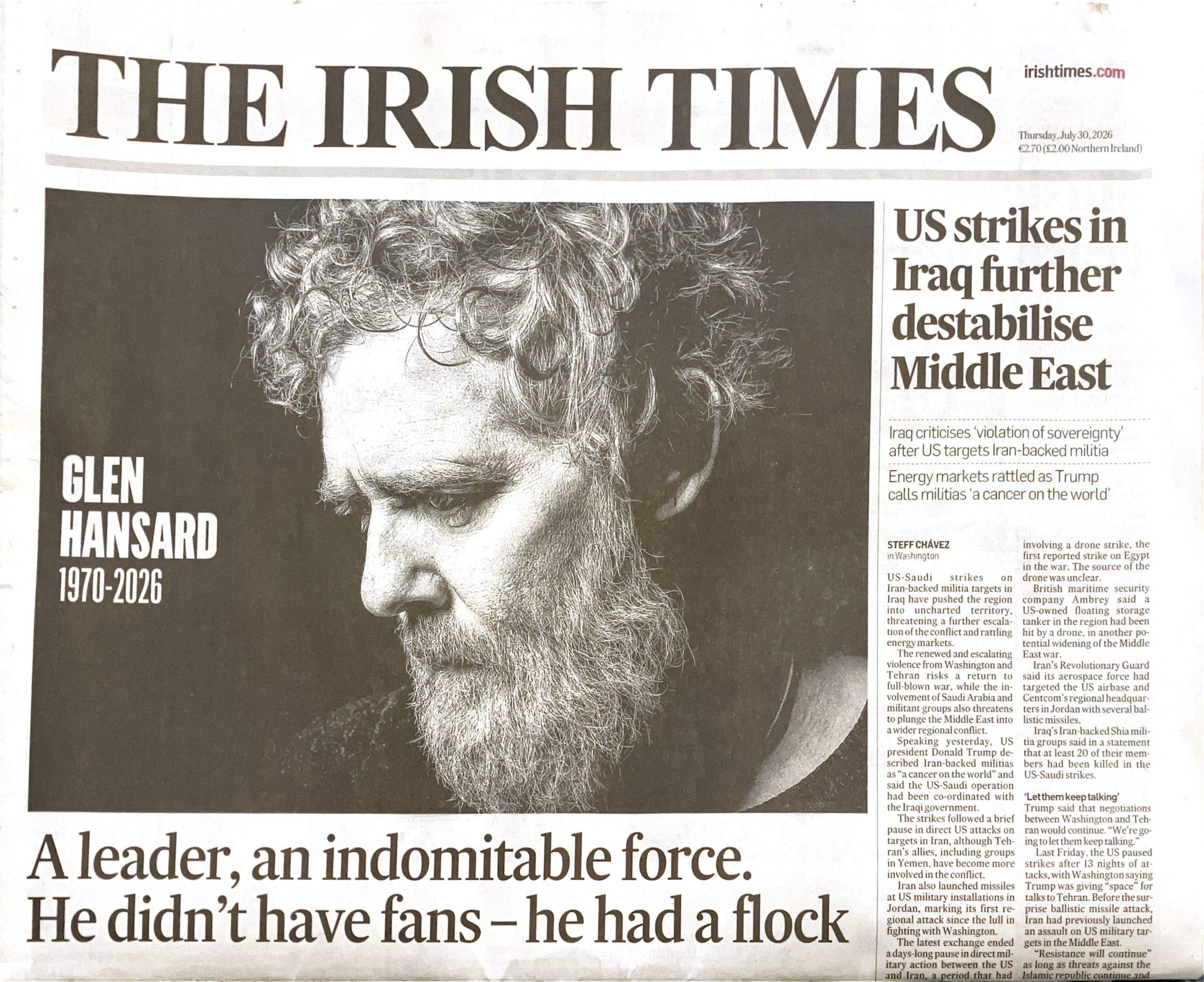
WhatsApp pinged. ‘Glen Hansard’s dead’, someone wrote.

Over the next couple of hours, a couple of group chats with university friends kept pinging away. A bunch of people from the same era, all gig-goers or musicians, swapping disbelief and stories.

When we went off on holiday for a few weeks, I took a break from writing these little self-serving posts, with the remaining list mapped out. It was going to end with what I think of as the GHEU – the Glen Hansard Extended Universe – because Hansard sat at the nexus of the group of Irish and Northern Irish musicians who heavily inspired me as a young, twenty-something songwriter. And then this happened, and it’s time to jump ahead a little.

I was too young to get the Frames in the late ’90s; my introduction came through the gift of copies of their back catalogue as a student (can you imagine, kids, you actually had to copy a physical CD to share something you’d heard with someone else.)1 I’d heard Fake on the radio, but that was probably all I was really aware of. The album that stuck the most was Dance the Devil, and it picking a single track for this list feels like grabbing something at random – but we’ll go for The Stars Are Underground. In fact, the live version of this song on Set List is probably the definitive version: these are songs to be howled en masse, not polished in a studio.

The Frames have a lot of tracks that betray the influence of grunge and bands like the Pixies, and this one is up there.

Thousands, possibly millions of words have been written this week, and I’ve nothing much of use to add to them. I first saw the Frames in those student days, but it was another record that probably, genuinely, changed my life a little. June 2006, I was living up in Belfast, staying in the chaplaincy houses on my own as I worked the floor of a local hotel in the evenings. It wasn’t a great summer; I got my driving test, but otherwise was often fairly lonely.

I took myself downtown in Belfast – this was when there were still shops you could enjoy going to – and a regular haunt was Zavvi, the former Virgin Megastore. One of my classmates worked there and it was good for hanging around. I came out that day with two brilliant albums, which unusually I had bought even though they were new and not on offer. One was The Life Aquatic Studio Sessions by Seu Jorge.2 The other was, bought on a whim, The Swell Season.

I was in an alt-rock band at the time. We were alright; the songs were straightforward enough to write, and (enough) people came to (most) of the shows and bought a few CDs. But this was the kind of music that I recognised as art.3 Glen’s genius was that he wasn’t particularly shy about wanting to be on the big stages, making something of worth, something that would move people, and being recognised for it; and yet simultaneously always came across as keen to elevate others and share the limelight around. And I think that’s probably why so many other artists I admire were so bereft at his passing, because they’d been part of that.

The Swell Season encapsulates the collision between songwriting, music, and art. Even the CD sleeve was beautiful. The songs orchestrated by this four-piece band, the cello in particular filling a sonic space in between mids and deeps so warmly. Songs like Sleeping and Lies shouldn’t be missed, in between the behemoths of Falling Slowly and When Your Mind’s Made Up which became staple covers for years after.

So a tip of the hat to Glen. It was lovely to spot some of the stars out for his (decidedly secular, even though it was in the cathedral) funeral yesterday; lots of familiar faces, now all a bit older and a bit wiser, singing their songs.4 It’s proven that the Irish approach to bereavement and grief is decidedly healthy, as we grieve in community, through stories and songs, sobs and smiles. Ní maith liom do thrioblóid.

  1. This reminds me about an article on the joy of old-fashioned music piracy, which is on the list to write some evening soon. There are still stacks of cassette tapes somewhere with my spindly handwriting on them, many taped off the radio. ↩︎
  2. Which is brilliant. Just brilliant. I don’t know why I haven’t given it an entry on this list; this list is so flawed. Go now, listen to Life on Mars in Brazilian Portuguese on acoustic guitar, and then come back feeling a little better about the world. The production on that album is so clean. ↩︎
  3. I kept Glen’s Oscar acceptance speech on my iPod for years – ‘Make art! Make art!↩︎
  4. How about Eddie Vedder. Again, how is Eddie Vedder not on this list? We’ll sneak in Rise here in the footnotes. ↩︎

40×40 // 26 – Awkward Annie (2007)

The start of summer. There was a time in life this meant the start of ‘summer teams’ season; packing off to a church hall somewhere for a week, or to summer camp, ready to run clubs for kids and teenagers. That slowly became festival season: first as a photographer; then as a production dogsbody on the A/V side; then, later, as an occasional venue manager, risk assessment in hand. All these things meant teamwork, regular all-nighters, too much coffee, and just trying to stay on top.

In between duties, you might have often found me tucked away behind a stage somewhere, earphones in, breathing deeply and trying not to unload on whoever had sinned against my planning. As a result, I completely associate these moments in life with a seesaw mix of soothing alternative folk and rock bangers.1

Kate Rusby’s album Awkward Annie epitomises the former – plenty of breathing space on an album of little episodic stories, best known for the lead single Planets but full of just enough lament to calm a racing mind down.2 A folk singer so talented, she should have been Irish.

  1. For example, summer means: I’d Rather Be With You and Better Together, but it also means The Ataris top class cover of Boys of Summer. ↩︎
  2. A special mention for the album recording of High on a Hill, featuring Chris Thile – one of the few mandolin riffs simple enough that even I can play it. ↩︎

40×40 // 25 – The Night Song (2021)

This particular day is a slightly unusual one. Tonight, my colleague Karen and I are due to be licensed as ‘probationers for the Christian ministry’ – aka, we’ve just completed three brilliant years of formal training at Union Theological College, alongside placement in various churches,1 and now are accredited in our home church to go and serve in our new one as assistants.

This month has been full of them, and we’re the last out of the gate. It’s also a little unusual (these days) because both of us have come from the same church, where we were (at the moment of writing, still technically are) elders, so double the fun.

Like most of the services of this kind, it is mostly other people doing things: except in the middle, where we are licensed – we come up and answer a series of questions publicly to affirm we understand and commit to our profession of faith and working within the Presbyterian system. This week – even though I’ve heard them several times recently – I was looking back over the questions we will be asked,2 and I stuck a little on the second one:

‘So far as you know in your own heart, have you been induced to seek the office of ministry from love to God and from a sincere desire to win souls to Christ and to promote God’s glory?’

I paused a little to examine myself. Is this the reason I have gone through all this? Or could it be for less altruistic reasons? Job security? A certain type of status? The opportunity to badger a captive audience? And so on…

One of the motivators in my life to ultimately pursue ministry was the slow, dawning realisation that, like most professions, those whose serve the church as pastors and teachers do not (or should not) feel any more like an expert than the rest of us. Each are talented in different ways. Some are great explainers of things. Others are talented personal evangelists. Some are natural entertainers. Others are more cerebral. And actually, within a local presbytery – group of ministers and elders – it is most useful to have a healthy range of these things.

During weeks like this one, where I have felt fairly inadequate, this is always an encouragement.

The Night Song is a lesser known collaboration between CityAlight and legendary (in a particular niche!) singer-songwriter, Colin Buchanan. The first time I tried playing it through for our littlest kids, it completely threw me emotionally, but we soldiered on. It is a quiet little song, a lullaby really, but psalmic in its lyricism as it reminds us that God will keep us, no matter the circumstances.

For the first few years of parenthood, I always felt a little silly singing to our kids, despite (as long-term readers will know) taking far too much pride in my relatively short and completely insignificant time as a gigging musician. Yet once I got over the hump, it is a great source of learning and of enjoyment. Little songs like this allow even someone who feels shy about it – like me – to teach some simple truths that people might carry for the rest of their lives. Because they so often do.

On occasions, when I have been privileged to sit beside someone coming towards the end of their life in a care setting, these types of songs are the ones that come to mind. People do not often find comfort singing elaborate worship pieces. They sing, Jesus loves me, this I know. They sing, The Lord is my shepherd. I suspect, in a few decades, some may sing, Jesus says when I am lost, I should come to him or maybe even something like The Night Song. And it is a most holy thing to be with them, and even to join in, when they do.

So I will attempt to sincerely answer the question above, as worded, when we are licensed later, with memories like this in mind. Of sitting beside our youngest, tapping away on the piano and singing to her that God will hold her through the night. Of sitting beside an older person as she began whispering to herself, I to the hills will lift mine eyes. Of preparing to speak this Sunday evening on the gift of faith, freely given, to all who will place their trust in something outside of themselves. Does this qualify as winning souls and promoting God’s glory? Perhaps it does – one quiet, holy moment at a time.3

  1. Shoutout to the heroes of First Dromara, Ballysillian, Dundonald, and our current home at Hill Street. ↩︎
  2. Paragraph 291.1.3 if you’re interested! ↩︎
  3. 1 Kings 19:11–13 (NIV) – The Lord said, “Go out and stand on the mountain in the presence of the Lord, for the Lord is about to pass by.” Then a great and powerful wind tore the mountains apart and shattered the rocks before the Lord, but the Lord was not in the wind. After the wind there was an earthquake, but the Lord was not in the earthquake. After the earthquake came a fire, but the Lord was not in the fire. And after the fire came a gentle whisper. When Elijah heard it, he pulled his cloak over his face and went out and stood at the mouth of the cave. Then a voice said to him, “What are you doing here, Elijah?” ↩︎

40×40 // 24 – The Stars Over Kinvara (2021)

Probably around 2005 or so, a uni housemate lent me Songs from a Room 2, the second CD compilation from the RTE series Other Voices. Other Voices walked so that things like NPR’s Tiny Desk Concerts could run, honestly. Glen Hansard presented the first series. That second album had a number of artists I ended up trying to see live, and some songs that stayed with me a long time: the electrifying Your World by Declan O’Rourke being one of them.

Years later, and with Father’s Day looming this weekend, I’m minded of another of Declan O’Rourke’s songs: the deeply moving The Stars Over Kinvara, a meditation on fatherhood and the sense of reflection it instigates, and the connection it curates, upon one’s own place in time and space. The eponymous recurring line in each chorus lands perfectly.

I only discovered this week that it was produced by Paul Weller, but that fits too: it has an acoustic guitar tone you would sell your house for.

40×40 // 23 – King of Wishful Thinking (1990)

There’s no deep reason behind selecting this song. It’s poppy. It’s fun. It’s a cult classic. It makes me happy. And the lyric is actually fairly moving in isolation – the narrator attempting to talk himself out of his heartbreak.

The New Found Glory cover is incredible.1 The shot-for-shot remake with Paul Rudd (also on vocals) and Jimmy Fallon is dedication to the bit par excellence.

Sometimes our attachment to music (or any piece of creative art) is because of its relationship to a significant moment in our life, or the emotion it provokes. Or both. And sometimes, it’s simply because it slaps.

  1. There are some bangers, generally, on NFG’s From the Screen to Your Stereo records – if we’re picking another, let’s say Stay with Lisa Loeb also re-recording her vocals. ↩︎

40×40 // 22 – Standing Outside the Fire (1993)

World Cup Fever has officially taken hold in our house, as we await the tournament kick-off, one week from today.1 I was chatting to some folks earlier in the week whose first tournament memory was France ’98 – a good one – but I go back four years earlier to USA ’94, and specifically Ireland getting out of the group stage only to lose to the Netherlands in the next round. There’s still a branded USA ’94 McDonald’s toy knocking around somewhere.

The tournament famously ended with Roberto Baggio missing his penalty to hand the trophy to Brazil. My memory is that it was on TV late – certainly post-bed-time for seven-year-old me – but I saw it all thanks to my partner-in-crime, my Nana. We were staying “down home” for a few weeks over the summer, as usual, but as soon as my parents went up the street for the evening to the pub, Nana would let me sneak up to watch TV: and seeing the Seleçāo lift the trophy is a core childhood memory.

The same summer, Nana was at peak fandom – Garth Brooks fandom. And the other thing I remember sitting up to watch with her was a Brooks concert film on TV, which she loved. It’s not my favourite Garth Brooks song,2 but the one that I have the clearest memory of was her awe at his hit, Standing Outside The Fire – and a key debate about whether, for the particular performance on show, he was wearing flame-retardant trousers!

Listen, Garth Brooks sounds cheesy, but will be forever associated with this favourite aspect of my childhood, so it is cemented in place. Nana passed away when I was nine, so memories aren’t always the clearest. Several memories endure: I picture her laughing at my cousins and I dancing around the kitchen, someone blasting tunelessly into a mouth organ; picking gooseberries off the bushes in her playground of a garden; shaking her head at us messing around at the summer scheme we were sent too, where I think she was helping out as first aider.

I remember her appearing on the Late Late Show along with half the town, and this being A Big Deal. I remember her tutting at my uncle Bobby for filling us up on ice cream (HB sliders, cut straight from the block) on the way home from the bog, before we’d had our dinner. I also remember her, towards the end, struggling to vocalise as she fought aggressive cancer from her hospital bed in Dublin. But I prefer to remember her lastly, standing, silhouetted in the doorway, waving us off as we set off on the long journey back up north each time we left.

And she loved Garth Brooks, and his potentially-flame-retardant trousers. So this one’s for her.

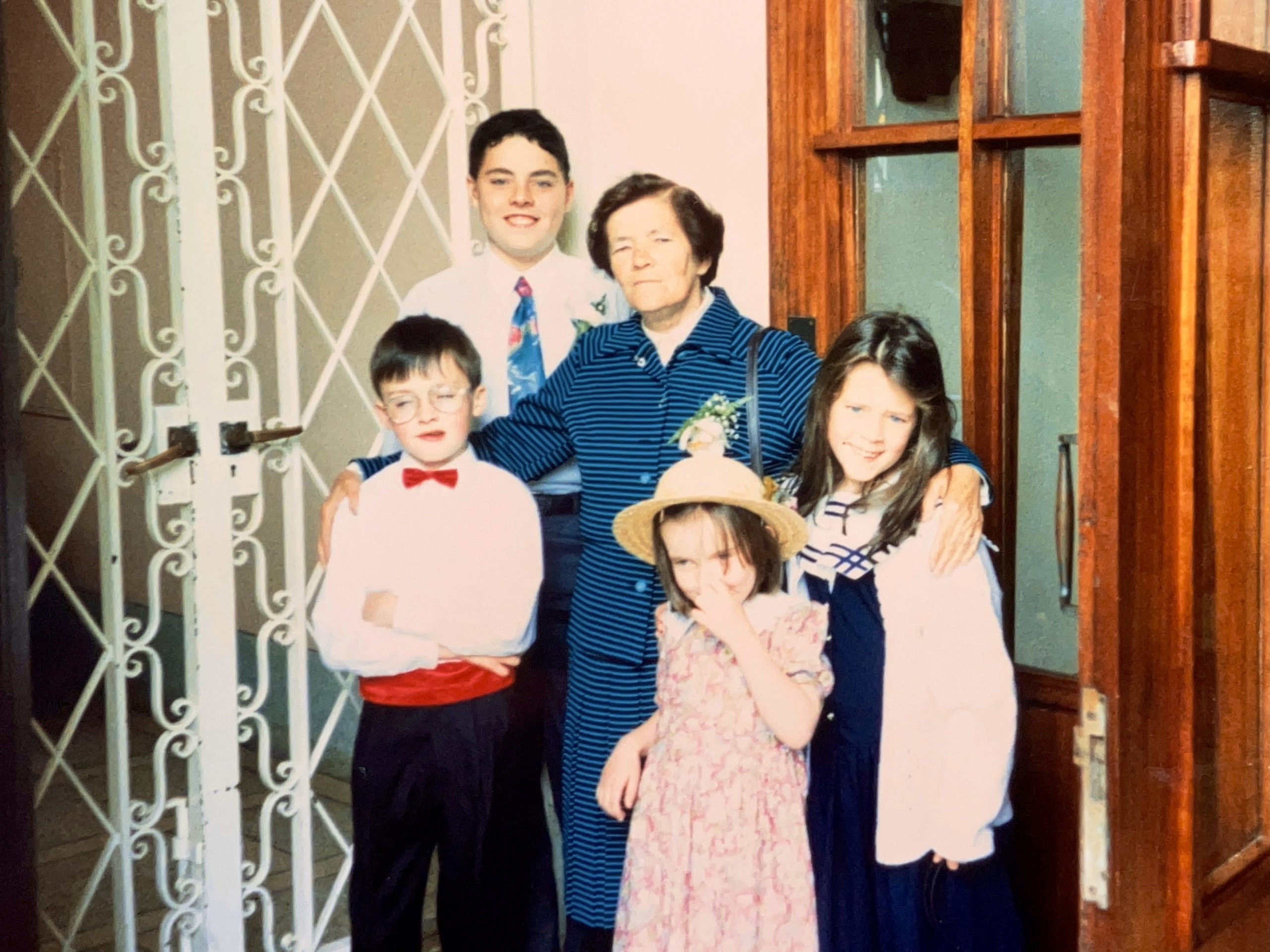
With some of the gang – August 1994. That red cummerbund was the source of a legendary falling out.
  1. I count at least three wall charts already erected on the wall, but pride of place, as always, goes to the latest design by Elliott Quince. Elliott has been selling his wall charts for years to raise funds for Luton & Dunstable Hospital’s Neonatal Unit, and his charts are the best – you might still be able to get one here. ↩︎
  2. I endured a lot of Garth Brooks at his peak – the Irish love him – but it’s a toss-up between the humour of Friends in Low Places and the absolute caricature of Callin’ Baton Rouge. ↩︎

40×40 // 21 – Mulholland Drive (2012)

It would be stupid to try and tell you that the music you’re listening to is like nothing you’ve ever heard before. The songs on the Gaslight Anthem’s latest album are three or four minutes long, most of them, and they’re played on loud electric guitars, and there are drums, and to be honest, if you haven’t heard anything like this before, then you’re probably listening to the wrong band anyway.

So writes Nick Hornby on the liner notes for the 2012’s Handwritten, an album which serves as an unflashy advertisement for why long-play records are not simply a collection of desperate tracks thrown together, but rather (at their best) a narrative arc strewn across anything up to and around 70 minutes of singing and playing. I could’ve picked any number of tracks from this album at random, but I’ve plumped for Mulholland Drive primarily because the lead guitar riff at the end is simple, but a lot of fun, to roll your fingers over.1 Four minutes of tight rock, get in and get out.

I used to have a back-and-forth with someone about which band would be the most fun to be in. My stock answer, when I thought I was being pretentious (!), was Dave Matthews Band – a jam band, playing the same songs a different way every night. But actually, I have neither the stamina, talent, or hand span for that kind of thing. The better answer is The Gaslight Anthem. The songs are good; they are crafted to be short, with no baggy-ness; and most middling musicians can play them. That’s not meant as a slight, but a testament to musicians who write good songs and play them well.

In this respect, The Gaslight Anthem are spiritual heirs to their hero, Bruce Springsteen – there’s a great clip of the Boss joining them to play their first big single, ’59 Sound at Glastonbury years ago,2 and the mood generally fits well with the Boss when he’s in his Born to Run mood. It’s clever, but not showy; the words are carefully chosen – so many literary references – but not pretentious. It’s good, healthy rock music for a Friday afternoon, and I, for one, am here for it.

  1. I like this album because the theme of songs and songwriting, and what that gives and takes from the writer, runs throughout. Tracks like “45”, Handwritten, and Too Much Blood put the theme front and centre – with that it mind, it makes so much sense that they got the author of High Fidelity on board. Someone’s posted the full liner notes here. ↩︎
  2. Found it. Love the look on lead singer Brian Fallon’s face throughout, having the time of his life. ↩︎

40×40 // 20 – Decatur, or Round of Applause for Your Step-Mother! (2005)

Some time early in 2014, after we’d been away, come back, and slowly slotted back into a life that had only just been getting started in Belfast. At some point, Andrew got in touch with a booking slot for a folk night he was hosting downtown. I think I was probably very flattered – I had not played out and about for a few years – and quickly got in touch with friend Robin. Get the old band back together? Sort of? A few covers, a few originals, sure it would be fun.1

I have three core memories of the evening in question. The first, sitting (why did we sit?) behind the mics, looking out, thinking, ‘This isn’t working.’ The second is glancing over to Andrew, behind the sound desk, who looked like a man questioning his life choices. And the third was plopping down in a seat beside Hannah, who had kindly called down with a friend to check the night out, and responding to her consoling kind words with a, ‘I think I’m done.’ And I was. I’ve not played my own stuff anywhere since.

Yet, on reflection, there were many redeeming factors. One, the people mentioned above are all awesome. Two, the symmetry of playing a final gig with Robin, having also played the first one with him all those years before, was perfect. When I had reached out to him, I’d said something like, ‘You pick a couple.’ We had a ton of fun practicing in the caravan parked up at the house which he was renovating at the time, trying to absolutely nail the harmonies on Sufjan Stevens’ Decatur – what could be more enjoyable?

It’s often the simply little songs that are the most interesting – I was just listening to Damien Dempsey’s magical cover of A Rainy Night in Soho, a song with a three chord loop that stretches on and on, and yet as the layers build is (I think) captivating. Decatur is similar: in one sense, its meanders along for three minutes, but as it does so it is both slightly ethereal and, mainly, fun.

When did music stop being fun?

Well, it wasn’t fun that night in 2014. ‘I had my fill, and I know how bad it feels.’ But these days, listening to various sounds rattling around this house as the kids hammer on this or attempt to tinkle on that, it might be coming back around again.

  1. Was footering around with hard drives yesterday and dug out this. Some time in the late 2000s, we were hanging out and wrote and recorded a song called Evergreen. I hate listening to my strained voice, but Robin’s guitar sounds lovely. ↩︎

40×40 // 19 – Dare You To Move (2000)

Child #1 had a birthday (in the middle of exams this week), and amongst other things, his gifts included what has now become routine – a wadge of second hand CDs, sourced online, filling out his catalogue. Someone can be proud of their children for many things, but his growing ability behind a drum kit, and the fact that, when quizzed who is favourite band are, on many given days he might say Jimmy Eat World, reassure me that, as a parent, we’ve gotten some things alright.

He is – I am convinced – the foremost expert in the land on something a little more niche: the oeuvre of alt rockers Switchfoot, and it began with the discovery on our shelves of their best-known album The Beautiful Letdown, including the reworking of their best-known song: Dare You To Move. I thought about some of the other awesome tracks Switchfoot have recorded, but its hard to get past it.1

The Beautiful Letdown has had so many plays, we are genuinely on our third copy of the disc – the first being my own, from twenty-something years ago. We – he – now possesses everything they’ve committed to plastic. So in honour of birthday week, it had to be Switchfoot.

It didn’t start there though. It started with Colin Buchanan, then Semisonic, as mentioned previously. It progressed through a short-lived family room routine, dancing around to the absolutely sensational Gregory Porter jam, Liquid Spirit, then later into a mini-U2 obsession and finally indoctrination with John Mayer and Jimmy Eat World. Been trying to get him into The Gaslight Anthem just this week.

They say your children are the distillation of your best and worst traits. If one of my worst is early-century soft rock, then its absolutely true.

  1. I have a soft spot many of their tracks, including Ammunition off the same album, and from much later, the re-recording of their album track Won’t Let You Go featuring Lauren Daigle. ↩︎