Blog

  • 40×40 // 07 – Flightless Bird, American Mouth (2007)

    In moments of darker humour, I have sought to unsettle a person by remarking that, regardless of what opinion they have formed of me thus far, they should know that I was present at the national premiere of The Twilight Saga: Eclipse. Reeling from this information may send an individual judging me in a different light, but don’t blame me: blame my (then) long-term girlfriend and her coping mechanisms.

    Part of that coping mechanism was, for a time, an attachment to a song that appears near the end of the original Twilight film – Iron & Wine’s quietly epic Flightless Bird, American Mouth.1

    Next week is our fifteenth wedding anniversary2, in the twenty-first year of our relationship – but of the handful of songs that I can say with any certainty that my wife actually enjoys, this one is right up there. For our first anniversary, which we celebrated a very long way away from here, her gift was a hand-illustrated card adorned with the lyrics of the song – I was certain I had a photo, but cannot find it.

    Our first dance was Come Fly With Me.3 Our first home often reverberated to either Mumford & Sons’ Sigh No More or Paolo Nutini’s Sunny Side Up (also a favourite of her children for a long time).4 But Flightless Bird – ostensibly a story about the loss of innocence and the wafer-thin line between dream and failure – remains her theme tune in my head.

    For what it’s worth, I think we’ve fallen on the right side so far.

    1. I’ve included the track in the body of the article, above, but maybe the best way to enjoy it is through the lens of Song Exploder Episode 243, where Sam Beams talks Hrishikesh Hirway through the process from demo to production – a great episode. ↩︎
    2. Just last week, I found this little clip on Vimeo from behind-the-scenes at our wedding – everyone goofing around during the signing of the register whilst the wedding guests were all listening to our lovely friends singing in the church. ↩︎
    3. This counts as a Sinatra reference, so I get to shoehorn in a mention of my favourite Sinatra-related piece of pop culture ever: John Mayer, on David Letterman, covering In the Wee Small Hours of the Morning. ↩︎
    4. My brothers-in-law made up our wedding band, along with the wonderful pre-Ferna Ferna, and the mythical, amazing Rick on trumpet. They absolutely smashed Paolo Nutini’s Pencil Full of Lead out of the park. ↩︎
  • 40×40 // 06 – Superman (It’s Not Easy) (2000)

    This week was heading in a different direction; but the news on Thursday of the passing of the actor James Van Der Beek weirdly resonated. One of those actors whom millennials weirdly probably saw a huge bunch of his body of work: Varsity Blues, The Rules of Attraction, in later years Apartment 23, and of course, Dawson’s Creek.

    Dawson’s Creek sits in a weird emotional space: I have seen less than half of it, yet the character of Dawson Leery resonated so definitively (Film school? Check. Spielberg obsession? Check. Inability to articulate actual feelings in any healthy way? Check check.) As a piece of television, it sits in a bracket that I wouldn’t knowingly let my own kids watch; but for this teenagers in the late 90, the actual characterisation, stylised as it was, tickled that love of smaltzy American comedy drama deeply.1

    (I actually have a Spotify playlist called Joey, Through the Window.)2

    Of course, a key element of these shows was always the soundtrack. I studied with someone who ended up being a music supervisor for TV later in life – talk about your dream job. And I realise now, skimming the Wikipedia pages for the Dawson’s Creek soundtrack albums, that this allows me to tangentially jump right into the great forgotten musical genre that kids today just don’t get – the homemade mix tape (or in our generation, CD).

    I had a friend in school who was an enthusiastic purveyor of mix CDs – and they were dominated by this same sub-genre of 90s/00s American adult/contemporary/soft rock music. His compilations became a primary source of a whole host of tracks – not music that would ever bother the UK Top 40, but music that was nonetheless often familiar from TV, movies, and music television. A prime example – all of Five for Fighting’s America Town, but particularly the lead single Superman.3

    The SFX of the music video have not dated well – but this is prime, ‘As heard on…’ music; no-one cares about the video.4 Moreover, John Ondrasik provided teenage me with ample ammunition for tiny subgenre of piano-led soft rock which, as a pianist first and foremost, was always welcome.5 I remember playing covers of this all over the place in my late teens.

    Those mix CDs supplied all sorts of introductions – Dave Matthews Band, Goo Goo Dolls, Barenaked Ladies, Joan Osbourne, Avril Lavigne… basically a huge block of the contents of my Last.fm for the late 2000s. Perhaps we’ll unpack a few more here as the weeks go on.

    1. We’re going to come back to this, but for me this is an arc typified by the content of T4 on Sunday afternoons – your OC, your One Tree Hill – but also widens to include everything that I watched on Channel 4 in summer terms when we were on revision leave – Ed (that’ll be mentioned again), E.R., weirdly Without a Trace purely in terms of scheduling. Was Joan of Arcadia in that bracket too? The other big time block was RTÉ2 (then Network 2) on Monday nights, with a prime comedy slot including Scrubs, That 70s Show, Friends – so much incidental music. This emotional arc probably runs well into adulthood and at least as our last big box set start-finish watch, Friday Night Lights, a decade after everyone else. ↩︎
    2. The only feature-length screenplay I ever completed (outside of undergraduate work) was partly inspired by a moment in an episode of Dawson’s Creek. True story. Though it was otherwise mainly inspired by my attempt to profess my undying love for someone… via email. I found it on an old hard drive last year (the screenplay, not the email), re-read the first few pages, and died inside all over again. ↩︎
    3. Superman is on Vol.2 of Songs from Dawson’s Creek, along with Teenage Dirtbag: there’s an epochal life story involving that song coming much later in the year. ↩︎
    4. Wikipedia says it was featured In a key sequence on Smallville. Yep, that fits. ↩︎
    5. I know people love it – I do too – but you can only play A Thousand Miles so many times. Though you should watch Vanessa Carlton’s ‘The Story of…’ minidoc for Vice – a rough ride. ↩︎
  • 40×40 // 05 – How He Loves (2005)

    Sometime, maybe around 2009, I was sitting awkwardly at a low-key concert (some kind of coffee bar style thing), when a musician friend, Andrew, ambled over.1 He’d been in the States for a year with his bandmate Steven,2 and had come back with a bunch of war stories which I enjoyed hearing. And he mentioned that Steven’s brother-in-law was this up-and-coming singer-songwriter who, in Andrew’s opinion, was the real deal.

    A while later, I remember driving to work on a Sunday morning with the iPod hooked up to the car stereo, and a song I didn’t know came on from some freebie sampler collection (remember those?). And I sat in the car until the song had finished, and played it again. And again on the way home. I found the CD sampler, which had embedded video files (again, remember those?), so stuck it in the computer. And when I watched the video – there was a glimpse of Andrew, bouncing around in his blue T-shirt in the background – and I realised, ‘Oh: this is the guy?’

    ‘The guy’ was John Mark McMillan; the song, ‘How He Loves’; and in my opinion, the rulebook for contemporary praise and worship, such as it was, had been torn up forever.

    In my lifetime, contemporary praise – aka What We Sing At All The Things – had rapidly evolved from Graham Kendrick and friends, through to the rock orientated – but less geared for corporate singing – more acceptable end of American CCM music. I enjoyed seeing both Third Day and particularly David Crowder Band in that period; but even at by the early 2000s, the emergence of the behemoth Hillsong Music was shifting things up to a level of slickness that would lead to a backlash.

    John Mark McMillan is not contemporary Christian music by any stretch – rather, like the Switchfoots of this world, a musician who writes about what matters to him, and what matters to him are often big questions about faith. But his talent is in mining a vocabulary that puts into the air words that sound real – not the limited range of the corporate Christian machine, but like the best poetry, words that paint a portrait of a heart and mind processing life in the presence of an infinite king.

    The hunger of such music drew a line, however indirectly, to the explosion in stuff like Housefires a decade later3 – which of course, then led to the machine taking a turn, like so much of our culture, to more ‘authentic’ sounds in praise and worship. But throughout his body of work,4 McMillan has continued to innovate and find words to express meaning for his journey, and it is always heartening to me to go back and hear a range of songs that sound like a man crying out, in praise, exploration, or grief5 – or, like life, very often a mixture of all these things – and very many other voices joining in.

    1. Andrew’s got a good back catalogue, both as a band leader and a solo artist, but a personal favourite is this soaring performance with the Ulster Orchestra, reworking a track from his eponymous album. ↩︎
    2. The genius multi-instrumentalist, Mr Stephen Williams, of Sons of Caliber, Jude Moses, and of course – John Mark McMillan. ↩︎
    3. These days, this kind of ↩︎
    4. Let’s pick a few: Death in Reverse (2018); Borderland (2014); and Death in His Grave (2010) are three great tracks from three great albums, but there are many more. ↩︎
    5. How He Loves has a significant back story, stemming from a tragic accident, and leading to a difficult third verse which McMillan rarely performed live as the years went on. But the story, as he tells it in this song story video, is beautiful. ↩︎

  • 40×40 // 04 – I Don’t Know (2008)

    I don’t know (no pun intended) about an annus horribilis, but certainly the winter of 2008/09 was probably the lowest point of my adult life. Still, holed up with good friends in a little house off the Lisburn Road (a room for which I could not even afford the rent, and often relied on their charity) music was a refuge. The house had an odd-shaped back hall extension which I lived off, and we filled it with the drum kit and keyboards and amps and would fill it with a therapeutic wall of noise bouncing around off the entirely unsuitable tiled floor and plain boxy walls.1

    That dark winter season was also filled with discoveries, chief among the Bon Iver’s Blood Bank EP2 and Lisa Hannigan’s debut solo album Sea Sew.

    Hannigan was best known up to this point for being the best voice on Damien Rice’s heart-wringing O and 9 albums, and Sea Sew presented an entirely different tone and narrative – still very Irish and very handmade, but one dominated by an optimism that bubbled up and over. The first thing I saw/heard was the little live video above. Later, in 2009, we made the trip up to Derry to see The Frames for the umpteenth time at the Millennium Forum, and the support was Lisa and this full band – and the joyful noise was real and infectious.3 We were able to meet the band afterwards4 and they came across as a group of people in the best moment of any project – that feeling of the magic just taking hold as things come together, before anything happens to bring one back into the real world.

    Future albums deserve a listen as well, but the raw chemistry of Sea Sew, as illustrated above, makes it, for me, a warm memory in a sea of tumult.

    1. This was dominated by tracks from John Mayer’s Where the Light Is and Kings of Leon’s Because of the Times, and we will stood by those choices even when the neighbours begged for mercy. ↩︎
    2. A four-track wonder that sounds like being parked in a fogged up car in a frozen car park on a winter night, waiting for someone to turn up. ↩︎
    3. My uni classmate Will, who ran a great live music project called The Bandwidth Sessions for years, which Lisa recorded two tracks for. The whole channel remains a delight, and increasingly a time capsule of better days. ↩︎
    4. I went back and found a blog post I wrote at the time. No, my writing wasn’t any better then either. ↩︎
  • 40×40 // 03 – The World Ain’t Slowin’ Down (1998)

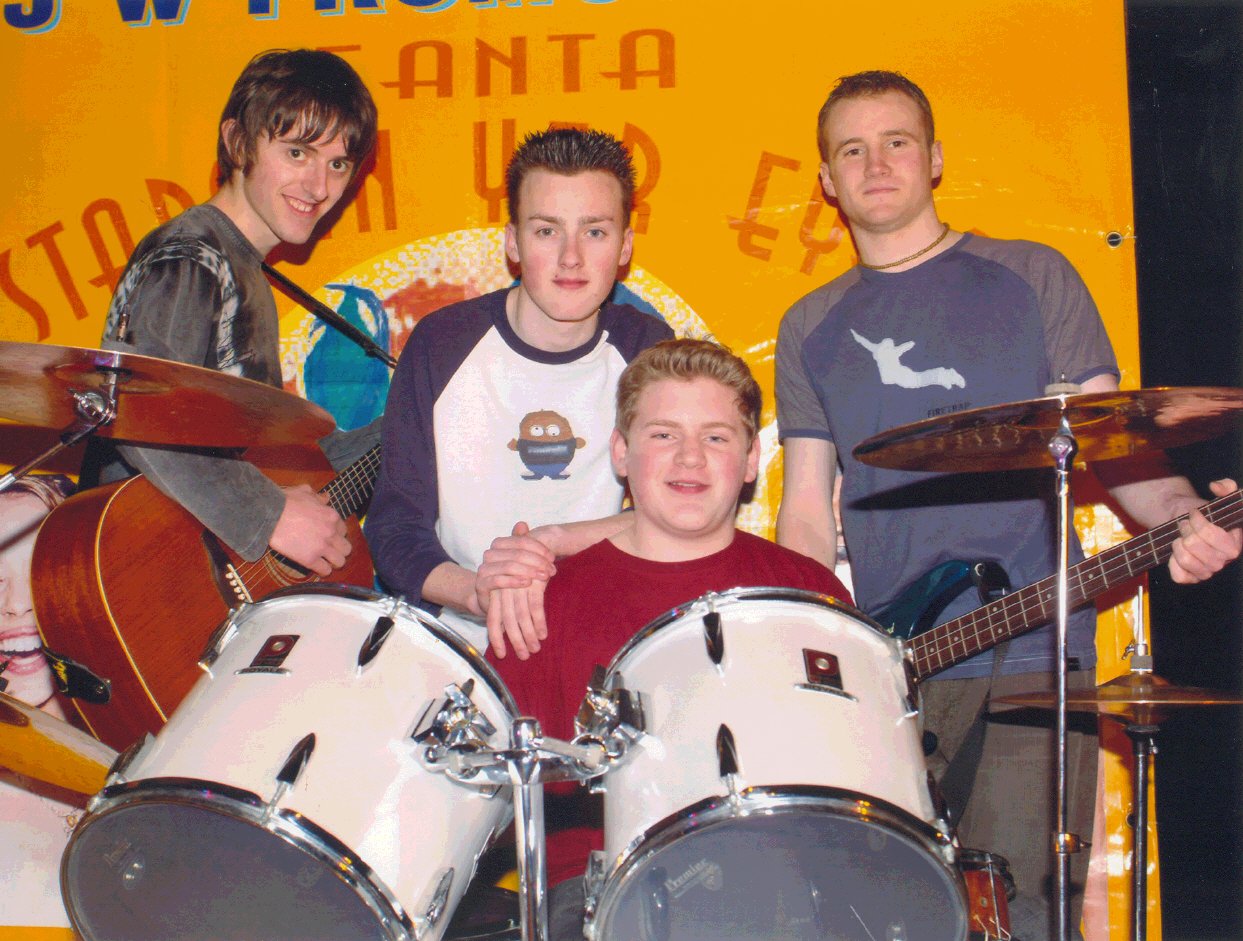
    Whilst about to begin a different anecdote about this song, a mild episode of PTSD has occurred – a flashback to a moment in the 2000s. Whilst still at school, a makeshift band were asked to perform a couple of songs at a fundraiser (a fashion show, no less, to which I inexplicably thought it would be a good idea to wear a cartoon t-shirt I had designed myself1). I believe the two songs we performed were Ironic and this: an obscure album track by folk revivalist Ellis Paul, given prominence by its appearance over the end credits of Jim Carey’s slapstick Me, Myself & Irene. In my caffeine-fuelled flashback, the room was stonily silent throughout: not for the first or last time!

    When I first heard this song, during a late night movie-binge at my cousins, during the summer break of 2001 or 2002, it was one of those things where you had to scroll through the credits and write it down, then play on repeat off the VHS or DVD itself.2 Kids, in an era before streaming, it was probably then off to acquire it online from an (cough) alternative source, and then work out how to play it by ear.

    We’ve previously mentioned how musical tastes supposedly skew towards your teenage years – and I think that largely holds up – but a caveat to my own is I think my tastes skew towards the things I was watching in my teenage years, which, with TV and movies in view, often means retrieving things from the late ’90s and earlier 2000s.3 The impact of such music was profound – alongside the love of film that I contracted over those summers, hanging out and making terrible short films, the two would combine and lead towards setting out to study Film and Music together at university a couple of years later.

    Ellis Paul has a couple of other great tracks of note – Sweet Mistakes is a clever piece of writing, which also had fifteen minutes of fame on the soundtrack of another Farrelly Brothers’ film, Shallow Hal – but the innocent soul of this song, with a simple riff that even a clumsy teenager can handle, kept it a go-to song in my mind’s catalogue for many years.

    1. Alright, here’s proof. ↩︎
    2. Other imprinted tracks from this period: Aerials, Californication, and Frontier Psychiatrist. ↩︎
    3. We’ve previously mentioned the golden era of official soundtracks. ↩︎
  • 40×40 // 02 – Helena (2005)

    When Nickel Creek announced their indefinite hiatus in 2007, I was devastated; I had only discovered the summer prior, at the repeated urging of one committed summer team leader. It’s been a delight, then, not only on the occasions when they’ve reformed since, but on the wending journey through an extended universe taking in both solo efforts and a plethora of brilliant side projects1 to follow this influential and un-pigeonholable group of musicians.

    Picking a track feels almost like throwing a dart at a map, but I’ve plumped for 2005’s Helena – presented below in a pristine 2021 livestream.2

    One of the reasons Helena is perhaps a favourite is a fond memory of musical friends (and at different points, bandmates) Erika and Josh performing a full-throated, never-to-be-repeated cover at some point in the late 2000s. To be fair, given the absurd musicality of Nickel Creek’s members, it is probably one of the few songs most of us mere mortals could even consider trying to imitate.

    Chris Thile is the main reason I was delighted to be gifted a mandolin for my 30th; Sean Watkin’s 2020 collaboration with chamber musicians The Bee Eaters,This is Who We Are,3 was a key audible crutch during the pandemic. But more on the music of that surreal period in another post.

    They are my favourite group which I haven’t seen live, even though I have had the chance; regrets, I’ve had a few.4

    1. I mean, where do you start? Chris Thile’s Laysong sits somewhere between his solo singer-songwriter stuff, and his solo and collaborative renditions of Bach sonatas; then there’s Punch Brothers; the Goat Rodeo records; Watkins Family Hour (hands up for their cover of Not in Nottingham, from the best Disney movie that everyone forgets about); and the searing albums from I’m With Her. And that’s only some of their catalogue. ↩︎
    2. The original album recording – with the unexpected, soaring appearance of a full drum kit at the denouement – is here. ↩︎
    3. This one-off album is a sonic journey, but a sweeping cover of Paul Simon’s Graceland is a particular highlight. ↩︎
    4. For the live aesthetic at work, what about this 2014 Tiny Desk Concert? ↩︎

  • An Impression Upon the Mind

    ‘I have a memory like a … what do you call it? That thing in the kitchen you use to sift the stuff you want from the stuff you don’t. A sieve! That’s it. I have a memory like a sieve.’

    I appreciate this short article from Tim Challies, reflecting on the mixed bag of being a man of short memory – something I deeply identified with this morning, even as I tried to remember the name of someone I spoke to on Sunday past.

    One context he mentions is note-taking during sermons. I have a small library of Field Notes pocket notebooks stretching back many years at this point, which I carry most days and continually write down things. As I explained to someone over the weekend, sometimes it is for reference, but often I find it is primarily the act of writing something down which aids my own recall. (Hence, my weekly sermon notes very often also have a list of names scribbled at the bottom!)

    Analogously, I glance across at the second monitor where my Apple Notes app lies open. There, I have made notes – some short, some copious – on 506 books, chapters or articles over the last five terms of study at UTC. Last term, I began making notes on one book which it turned out I had already skim-read two years’ prior. At such times, I despair a little because it feels like I took so little in!

    However, Challies offers great comfort that it is the edification in the moment which has as great an impact on the heart and character, as any ability to recall:

    ‘[Jonathan] Edwards countered, ‘The main benefit that is obtained by preaching is by impression made upon the mind in the time of it, and not by the effect that arises afterwards by a remembrance of what was delivered.’”

    I’m convinced that what is true of sermons is true of life. And for that reason, I can rest assured that my satisfaction and sanctification are unaffected by my memory. I have been blessed, strengthened, edified, and encouraged, even when I don’t exactly remember how.’

    Read the full article here.

  • Paper Tiger

    Having (finally) forsaken micro-blogging in all its forms, it’s back to posting snippets such as this on a blog again. Nearly two decades ago, the artist now known as Good Swim played a set for me at a mini-festival hosted in our hayshed. Like everyone else involved, I still owe him.

    His new single, Paper Tiger, is out today. Already looking forward to the album when it comes. It’s on Spotify here, and Bandcamp below.

  • 40×40 // 01 – Gifts and Curses (2004)

    40×40 is a forty-week project, recapping forty tracks from the last forty years in no particular order to tell a few stories. The whole lot – plus many, many footnoted extras – are available on this Spotify Playlist (unless, like this week’s, they’re not!)

    So-called ‘lost media’ has been a bugbear for many, many years (and a reason I still, like a broken record, regularly cite Jeremy Keith’s 2011 talk All Our Yesterdays to anyone who will listen).1 I imagine the TV show Ed will crop up in a later entry in this series, a peak example of the medium – a show essentially kept off streaming because of the huge headache of transferring rights to a broadcast medium no-one envisioned when playlisting a whole host of great indie artists for the soundtrack.

    Stuck in such hell are a great many film soundtracks of the early digital era, amongst them 2004’s Spider-Man 2 – which contains a handful of great, unique tracks,2 foremost of which is Yellowcard’s Gifts and Curses.3

    Some say the music you are listening to in your later teens will be the music you carry through life: I was 18 when I got this OST CD, at peak pop-rock-transitioning-to-shoegaze, and Yellowcard were absolutely one of the bands regularly appearing on Kerrang! or MTV2 or whatever it was I was turning up and trying to play along with on the telly. But soundtrack albums are not where people’s best work end up: soundtrack albums are supposed to have a couple of big singles, and the rest is typically filler. There are exceptions, of course. But that this band chose to pour a significant amount of talent and creativity into a mid-track that, and this is crucial, really is actually based on and/or inspired by Spider-Man 2, is just fantastic. Production is razor-sharp; the mix is brilliant, with soaring violin; and the breakdown, though perhaps overindulgent, fits the product description as a soundtrack track. I believe it’s a fan favourite; and that, and only that, has saved it from the mists of time.

    Yellowcard had hits before and long after this,4 but I’m not sure it ever got better.

    1. Ironically, this series of films, which I had the privilege of directing and editing when working for Box42, almost became lost media themselves when they came off Vimeo a few years ago – at the time, the most well-known, When we Build by Wilson Miner, was at something like three million impressions – all gone. ↩︎
    2. I’m in big trouble with at least one other person on the planet for relegating Dashboard Confessional’s Vindicated to a footnote, but it appears on another record so it doesn’t count. ↩︎
    3. Sadly, I suspect the presence of a track from LostProphets means no-one’s campaigning for this compilation to be re-released. ↩︎
    4. The pick of the bunch is probably Ocean Avenue (with an incredible drum pop at 2:42), but as recently as late last year they put out You Broke Me Too, a great throwback featuring Avril Lavigne – which about twenty years ago would’ve definitely been worthy of blanket coverage on TRL or similar. ↩︎
  • 40×40 // 00 – Pregap

    Without wanting to give too much away to the crawlers – 2026 brings a significant birthday. The kind of one where your doctor sees your date of birth, and swaps the checklist. There are probably blue nitrile gloves involved at some point.

    Some months ago, I was ruminating and reflecting on this, and came up with the idea of listing forty songs from my lifetime thus far: not the best songs, not the most significant, necessarily; but, as someone who has loved recorded music from an early age, songs that conjure up memories. And so, since then, I have compiled a list of songs – many, many more than forty – and am now trying to whittle it down.

    The (admittedly self-indulgent) concept will be to publish a brief note about one song a week, probably along with a few footnotes to allow me to direct your attention to other bits of ephemera (and frankly, squeeze in lots of other songs). Forty songs for forty years over forty weeks; no more, no less. There is no order, and little logic: just vibes, nostalgia, and an unhealthy bias towards ‘as featured in [US TV show]’ in the 2000s.1

    This preliminary article – the pregap,2 if you will – has no other purposes than, firstly, to explain this once, so I do not feel the need to repeat it; and secondly, to commit to the concept by throwing my cap over the wall.3

    1. Let’s just all take a moment to give thanks for Christa Miller’s work as the music supervisor on Scrubs. ↩︎
    2. The pregap is the bit on a CD before the first track, where occasionally artists would hide a track only accessible by ‘rewinding’ just the right amount from the start of track 1. My favourite: Damien Rice, 9 Crimes (demo). ↩︎
    3. A story that comes from Frank O’Connor, but best explained by Jed Bartlet. ↩︎