Blog

  • 40×40 // 18 – Closing Time (1998)

    A mention of SongExploder a couple of weeks’ ago1 brought to mind the episode of that great podcast series which is the favourite of mine (and I expect, a lot of others) – where Semisonic’s Dan Wilson relates the process of writing their anthemic hit, Closing Time, with a life-affirming coda.

    Weirdly, for a period of time circa 2020, Semisonic’s album Feeling Strangely Fine became the one on permanent rotation in our family car,2 as Child #1 began making his way through his father’s CD collection. Just as COVID hit, it was nearing ubiquity, Late in 2020, when their father was often busy multi-tracking audio recordings for church services (remember when that was briefly an apparent necessity?) we had a sidebar recording children’s songs for our own amusement – children’s songs, and a full-band composite of Closing Time.3

    Until then, although I like Semisonic generally, I probably primarily associated this song with its repeated use at the end of live events, circa 2010–11. But the aforementioned SongExploder episode takes it to another level. Dan Wilson is one of the more prolific modern American songwriters, but he seems OK with this one being his epitaph.

    On the YouTube video, one of the top comments says, ‘Cheer up – in only 64 years it’ll be the ’90s again.’ Sometimes it seems weird that Gen Z and Gen Alpha seem to be developing a weird hazy, warm feeling towards that decade – but the rock scene, from the grunge to the pop, was absolutely sensational.

    In the next entry, we’ll pick up on the theme of children nicking their father’s CDs, but as an entry into grown-up music – this one was pretty good.

    1. See track 16. ↩︎
    2. …displacing, after more than a year, Colin Buchanan’s Colin’s Favourites, Vol. 1, most of which I could play and sing from memory at that point. Colin Buchanan probably won’t get an entry in this series, but is worthy of a mention: he will be best-known to the widest audience as the co-writer on a popular Christian worship song, Jesus, Strong & Kind (and I very much value another track also written with Cityalight, The Night Song), but to a significant subset of Christians – particularly Australian ones – he is an absolute phenomenon. A legit country singer-songwriter with a famous Christmas novelty hit, Colin turned to writing Christian music for children in the 1990s and is – and I do not say this lightly, but it is only my opinion – perhaps one of the finest expositors of Biblical theology alive on the earth today, taking deep concepts and recounting them for under-10s with silly voices and guitar riffs. Our family are immensely grateful for all his songs have embedded in our lives, with and without puppet accompaniment. ↩︎
    3. I just booted up the Adobe Audition files out of interest. That is a lot of percussion tracks. ↩︎
  • From bean to cup?

    This is very clever. Frank has launched a mapping web app called ori3.coffee, which represents the connections between coffee producers and roasters. Its niche, beautiful, and I love it.

  • 40×40 // 17 – Emer’s Dream (2008)

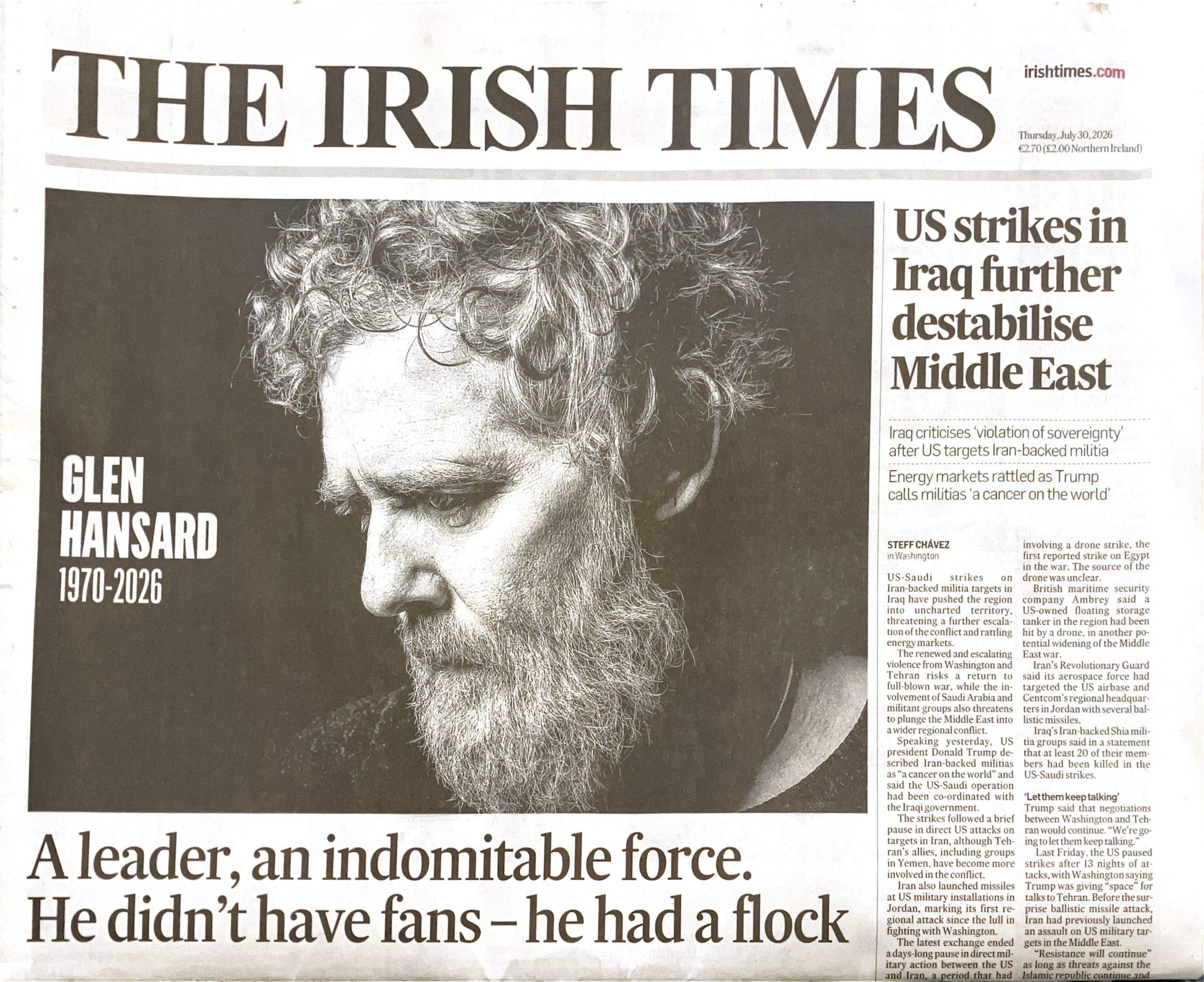
    We haven’t had a song by the Frames yet, but we’ve had a few contacts with what I’ll term the GHEU (Glen Hansard Extended Universe) already in this series.1 Today’s is the most explicit yet: the showstopping Emer’s Dream from Colm Mac Con Iomaire’s 2008 solo record, The Hare’s Corner.

    Now, remember: it’s late 2007. KT Tunstall hasn’t yet just been on Jools Holland with the legendary looped performance of Black Horse and the Cherry Tree.2 People – ok, people I know, including me – are taking a long hard look at loop pedals, but we’re still a few years pre-Ed Sheeran, so they aren’t mainstream.3 With no fanfare at all, Colm Mac Con Iomaire came out before the rest of the Frames at a gig in the Grand Opera House in October, and played a few tracks off his soon-to-be released album, running his electric violin through a loop station and creating these gigantic, whirling soundscapes.

    Youtube struggles to capture it, as is so often the case, but the sound created a, ‘take it, take my money’ moment.


    Completely tangentially, writing this has reminded me of perhaps my favourite moment in a rehearsal. For me, rehearsals were always the favourite part of a performance: the moment when a band have started to click, or when a new song gives everyone the ‘oooh, that one’s not awful’ feeling, or just little bits of musical magic. I remember playing at a fundraising concert some time after this,4 and was footling around playing the chord sequence from Emer’s Dream on the piano when friend Hannah, playing violin beautifully in that particular outfit, felt moved to start improvising along off the top of her head. In my very brief time attempting to be a jobbing musician (despite how much I nostalgically wallow in it) I got to try out lots of different things, but that little moment, noodling away in an otherwise empty church space, might be my favourite, as that chord sequences and the violin mixed and rose in the air, never to be contained or repeated.

    1. See entries for the pregap and track 04 for more. ↩︎
    2. The lore around said performance – including Tunstall’s late call-up as a replacement, and borrowed equipment – is almost as good as the song itself. ↩︎
    3. Friend Brian, these days a legit singer-songwriter, was the finest user of a proper loop station that I knew, but he was usually to be found in his student digs diligently mastering John Mayer solos over himself as the backing track. ↩︎
    4. The things you remember. We were supporting a fellow called Gentry Morris that evening, who is a fantastic singer and writer. You should watch him and Stephen Macartney sing his song, Awake, O Sleeper, and then go and listen to his album of the same name. ↩︎

  • The things that stay with you

    A lovely clip from an interview with Ardal O’Hanlon on the Late Late Show, where he reminisces with Patrick Kielty about his recently-deceased father.1 O’Hanlon’s father, the politician and GP Rory O’Hanlon, was not, in his words, the most present due to his tremendous commitments to community and state – but the younger O’Hanlon speaks particularly fondly of the times when, as a child, he was brought along for the house calls.

    I have to admit, this resonates deeply with me. My own father, a vet, was similarly constantly on the go, but I have warm memories of climbing in the car and being taken to all sorts of places: when he was still in practice, sat at tables, drinking juice whilst small pets were examined; perched on the end of a cattle crush, watching the dehorning with increasing disgusted; wedged on top of the wall as a group of men ran the herd through the sheep dip.2 Later, when he worked at the meat plant or for the department, Saturday mornings often meant time wandering around the mart, or memorably once getting to go and literally see the sausages getting made.

    It resonates now because I work in a role, in local church ministry, where you also spend a significant amount of time in people’s homes, and I too sometimes drag my children along. It is a reminder that, as they have already tried to say, they actually enjoy something of these times. I sometimes feel guilty for bringing them, as if they’ll be bored or uninterested, or as if they might need to be shielded from the realities of real life; but I suppose on reflection, there’s something magical about stepping into that grown-up world when you’re little, and there’s also something magical about being invited into it by your parent.

    O’Hanlon connects these times with his own sense of relationship to people; Kielty goes as far to prompt him that he, too, engaged in a type of public service and that may be influenced by his childhood memories. It’s a reminder, too, that no artificial construction or so-called social platform can replace the magic of face-to-face time alongside those who mean the most to you; and that, without the need for extravagant, ‘memory-making’ experiences, there is little that replaces the mundane joy of simply being brought along for the ride.

    1. Around a decade ago or so, a bunch of us happened to see Ardal O’Hanlon doing an afternoon warmup gig for the Galway Comedy Festival – I think there might have been around thirty people squeezed into a tiny room upstairs in the bar, and maybe ten were us rowdies. O’Hanlon was trying out material, opening confessing the bits that didn’t quite work and, in a very meta way, also explaining how he would put the act together for that evening based on what we as an audience were responding to. In person, he seemed exactly as warm and affable as you would imagine, and to be fair to him, the embodiment of what he describes in the clip above. ↩︎
    2. When I was maybe five or six, I famously took a tumble and fell off a wall, rolled across a small bit of yard, and ended up immersed in the tank. I must have been guaranteed mite-free for at least six months afterwards. ↩︎
  • 40×40 // 16 – Wait For It (2015)

    There are few pop culture hills worth dying on – but the admission by Lin-Manuel Miranda that he believes he wrote the best songs for the character of Aaron Burr encourages me to make this particular stand: Burr’s searing inner monologue, Wait For It, is the best song in the musical phenomenon Hamilton, and yes, I will die on that hill.1

    It is so significant that when Hrishikesh Hirway’s SongExploder briefly made the jump to Netflix for a (too) limited-run series, Wait For It was the track grabbed out of the zeitgeist to go under the microscope.2

    In the musical’s libretto, it’s perhaps one of only a couple of glimpses into Burr’s otherwise stonewall persona: a moment when the facade drops, and the man’s motivations are exposed.

    Whilst a particular line –

    Death doesn’t discriminate
    Between the sinners and the saints
    It takes and it takes and it takes

    …might be read as exposing a type of fatalism, I have often chosen to read it instead as a tenet of faith – death, which none of us can escape, is not only the great leveller but also a reminder that so many things in this plane of existence, which may seem vital at the time, are just dust.

    1. Allow me to shoehorn in here an honourable mention for the cover, by Ben Folds and Regina Spektor, of Burr’s other moment of vulnerability: Dear Theodosia. ↩︎
    2. The podcast SongExploder is brilliant, and will feature again – the Netflix series can be found here. ↩︎
  • 40×40 // 15 – Next Year (1999)

    Inching towards academic deadlines at the end of this month, 40×40 has not been getting the attention I would like. However, setting aside such distractions, and reviewing recent posts, one can spot a minor trend in recent entries which is crying out for resolution – that is, songs that primarily emerged from TV watching habits in the early 2000s.

    A footnote to an earlier post discussed the incredible run that was RTE 2’s (then Network 2) Monday night comedy lineup; today, a tip-of-the-hat is due to the UK’s Channel 4’s morning setup. The weekday early morning run of that time is legendary: on any given morning you could be watching Cheers, Frasier, Friends (heavily edited for the time slot), and if you missed the school bus, King of Queens or Everybody Loves Raymond. However, hang around until later morning and there might be ER, criminally-underrated procedural Without a Trace, and the sweetest of all early 2000s comedy-dramas: Ed.

    Ed remains slightly mythical for having never made it to DVD due to musical rights issues – a trap into which many pre-streaming shows fell.1 A vehicle for future stars Tom Cavanagh and Julie Bowen, the small town aw-shucks-fest mixed schmaltz with belly-laughs, but the soundtrack was a highlight – no more so than the original track for the opening credits: Foo Fighters’ album track, Next Year.

    Aged around 13, I knew Nirvana from my older cousin’s cassette tapes,2 but hadn’t yet discovered the Foos; watching Ed led to purchasing There is Nothing Left to Lose and my mind falling out of my ears.3 Yet, in contrast to most of the album, Next Year is a gentle lyric, wending its way through an ambling tune to create an audio landscape that perfectly fit the TV show it was used to introduce. This track and that album were a gateway into a whole world that part of my nostalgia-tinged brain still lives in. Maybe things will change sometime.

    Maybe next year.

    1. Vulture have a good explainer here. A few years ago, some absolute hero ripped the whole lot from what looks like the broadcast tapes from a local affiliate TV station in the States; the internet overlords have never seen fit to action a takedown, and you can watch the entire run on YouTube with 90s-style VHS flicker. Typical of the era, the finale, four seasons in, is a mess, but the joy along the way is worth it. ↩︎
    2. Like something out of a coming-of-age film, my cousin Seline spent a summer in our house and commandeered my cassette player to blast Nevermind on a daily basis, and her (maybe ten year old?) cousin was absolutely on board. Her most played track was not, as I remember, Smells Like Teen Spirit, but definitely In Bloom. ↩︎
    3. Dave Grohl’s best album. It’s been self-pastiche ever since; often enjoyable, but still a bit of a parody at times. ↩︎
  • LLMs and the Closed Web

    In attempting to describe a certain period of time yesterday, I referred to the late 2000s as ‘peak Twitter’: you know, the moment of time when the biggest concern on the web was Gowalla vs Foursquare; when people live-tweeted election results and you trusted the numbers; when you’d share actual photos of your family without thinking about who or what would be scraping that data for whichever particular perversion of humanity has the most commercial potential.

    For a couple of years, I had the privilege of working at Build conference in Belfast and related events,1 when cool people from the internet would come over from North America to hang with cool people from the internet from Belfast and Dublin and talk about Web Standards like we’d finally achieved something as humanity. And I mean that: the web was exciting, democratic, and the sort of things that had seemed only vaguely possible a decade earlier, whilst pushing box edges a few pixels to one side on the Geocities interface, now seemed tangible. Wilson Miner’s seminal presentation, When We Build, held up the potential of good, honest, human-centred design in such a way that I ended up studying it.2

    These memories are in my head having tried to digest Anil Dash’s terrifyingly prescient essay ‘Endgame of the Open Web’. Dash sounds like a prophet of doom and I fear he’s absolutely on the money.3 The overarching theme is the continual movement – sometimes gradual, sometimes rapid – of features of the open web towards the walled gardens of Big Tech for commercial gain. Money in itself is not bad – it can be exchanged for goods and services – but the typical outcomes are obscene profit which monetises people as the product, and subsumes smaller, more focused tech products which typically do one thing well, into bloated frankenservices which do many things badly. All the while, the things that made a standardised, open web beautiful become fodder for profit for companies (or nations) that are simply too big to sue.4

    LLMs won’t destroy us, Skynet-style. It’s more depressing than that. They’ll simply railroad human effort and creativity, disregarding any kind of ownership or license, gobbling up mind boggling levels of finite natural resources so that people can make bland videos of celebrities fighting, or whatever slop comes to mind. They continue the brain rot and keep people welded to their devices, spending ever more time, effort and money on trying to understand why they feel so isolated, lonely, and bereft of purpose and meaning.

    Dash’s reach means this might help to bolster the resistance online; but perhaps the best thing any of us can do is close our screens and do something else. I have kept my social media profiles, but rarely post.5 That’s not a niche thing: Ofcom recently brought hard figures to the assessment that more and more people are merely passive consumers of social media (even the name is a misnomer these days; when is the last time you opened a timeline – also a misnomer – on anything and were greeted by posts by anyone you actually have a human relationship with?) but nevertheless we continue to consume.

    Perhaps if more corners of the web could be returned to the old paths – and somehow protected from obliteration – things might improve. I’m not holding my breath.

    1. Refresh Belfast and the original BarCamps were also fun days out. ↩︎
    2. To the credit of Andy the organiser, Build had a great lineup of people every time, but briefly meeting (and then labouring in the editing suite over) people like Craig Mod, Jeremy Keith, Erik Spiekermann, Frank Chimero… just a wealth of interesting people trying to do good through design and art.. ↩︎
    3. Jay Hoffman’s response on History of the Web offers some glimmer of hope, and its worth reading both pieces together. ↩︎
    4. I don’t think anyone ever pegged Holden McNeil as one of life’s optimists, but one could almost weep about how simple that character’s description of the Internet sounds, 25 years on. ↩︎
    5. As much as I’d close them all in a heartbeat, the one time I closed an account – a secondary twitter handle, maybe a decade ago – within minutes it had been reacquired by an impersonator. ↩︎
  • 40×40 // 14 – These Photographs (2006)

    Whisper it – of all the millennial properties being revived in these current times, the reboot of Scrubs has bucked the trend and been both fresh and familiar in equal measure.1 (Frankly, I’m gutted there are only nine episodes in the first run). Admittedly, I am absolutely the target audience: it first hit TV when I was finishing school,2 and the boxsets came with me through uni (alternating purchases with series of The West Wing).

    Among the many things to like was, famously, the sound tracks, as mentioned in a previous post in this series.3 Music was used both in and out of camera to amazing effect – Colin Hay’s cameo might be the best example. But perhaps the greatest beneficiary was Zack Braff’s bestie, Joshua Radin, whose music is synonymous with some of the shows most famous moments.4 Scrubs, therefore, was also a gateway into Joshua Radin’s music; I was tempted to pick something from his (unusually upbeat) third album, Road to Ride On, but the Scrubs connection anchors us in the first record, and so I’m going for These Photographs.

    Radin specialises in breathy, heart-felt and quiet songs – and he’s very good at it5 – but I often think its a pity as his more up-tempo tracks, primarily limited to his second and third album, very on high quality pop. These Photographs sits somewhere in-between; I’ve always enjoyed the wordplay of the verses, casting various historical literary figures in a way that could feel very heavy-handed, but I think manages to say the right side of sincere. The album, We Were Here, is well worth a spin.

    1. Disney Plus in the UK – I’ve loved it. ↩︎
    2. It was on Channel 4 in the UK, but was also part of a frankly obscene Monday night lineup on Network 2 in Ireland, were us dual-nationals in the north could also tune in to see lots of US comedies weeks ahead of their UK screenings. At one point, the run was something like: That 70s Show, followed by Scrubs, followed by Friends, followed by Father Ted. Today, in a streaming world, no-one would raise an eyebrow, but at the time, there was nothing like it. ↩︎
    3. Let’s shoehorn in two things here: firstly, the show’s theme song itself, Superman by Lazlo Bane, and some lovely banjo; and secondly, you can’t mention Scrubs and music and not take a moment to pour one out for the amazing Sam Lloyd and his a cappella group, The Blanks. ↩︎
    4. Season 3, Episode 14 – ‘My Screw Up’. ↩︎
    5. Paperweight is a good example, from the soundtrack to The Last Kiss, an excellent – and forgotten – genre-twisting rom-com from the Scrubs extended universe. ↩︎

  • 40×40 // 13 – A Praise Chorus (2001)

    At friend Dave’s 40th birthday party last weekend, one of the first tracks on the generated ‘Indie Rock 2000s’ playlist was Do You Want To? by Franz Ferdinand. When we were roommates over two decades ago, the first two Franz Ferdinand records were on heavy rotation in Dave’s CD changer – along with Floggin’ Molly and Dropkick Murphys – and though I was never a massive fan, the time we went to see them in November 2005 was one of the all-time great concerts in terms of crowd participation. Those art-rockers knew how to work a big room; the bounce for that song was something else.

    It got me musing on other great gig moments. I’ve never been a massive gig-goer – certainly not arena-sized ones where you’re basically watching a big screen. Foy Vance was on the BBC recently getting misty-eyed about the Rotterdam Bar;1 it is incredible that we used to be able to wander across town and, for the price of a pint, sit in that wee dark room and watch artists like Foy or Duke Special doing their thing. Other favourites from that era included the Frames at the Ulster Hall, Dave Matthews in the Waterfront2 – sonically, a perfect match of artist and venue – Oppenheimer in a beer tent3, and Bell X1 at the old Mandela Hall. Then I stopped: the best Mandela Hall gig of all (in my time): Jimmy Eat World.

    For a long time, Work sat at the top of my last.fm all-time charts (before they were destroyed by my children’s access to Spotify); but as I mused on, there’s only one choice: the collision of lyrical precision and genius with the sweaty guitars of A Praise Chorus.

    The most recent time I saw Jimmy Eat World, it was getting to that slightly annoying stage where you could barely hear the band over an entire room full of people shouting every single word back at them – but on reflection, this is really just a testament to how, for a very specific age bracket of millennial, this band were seminal. That swell of guitars and the perfect production mix of vocals over the top – there’s so much going on, as the live video above hints, but on the album, Bleed American, you can hear every part.

    A later post in May-time will pick up on the music that has been adopted by our kids, but Jimmy Eat World is gladly one of those which our eldest, the drummer, has studied. Long may it continue.

    1. RIP. There’s an appropriate Facebook page of people sharing memories here. ↩︎
    2. For the DMB fans: what a setlist that was. ↩︎
    3. ‘When the city’s awake, you wanna go down to the subway to make your way… UPTOWN…’ An amazing live band. ↩︎
  • 40×40 // 12 – Everything You Want (1999)

    When the poster went up outside the Drama department, I walked past it a few days before putting the whole train of thought together. A couple of months earlier, under Bob’s guidance, I’d managed to scrape together enough to buy my first ‘proper’ guitar – a left-handed, dreadnought Tanglewood with a pickup – and had been schlepping it around, still in its cardboard box, to play for youth fellowship and the like.1 But it hadn’t had a proper outing. Eventually, I walked past the poster enough times to think, ‘Well… maybe that would work.’

    At the school open evening, weirdly enough, the pieces came together. Bob was a natural ‘yes’. My friend Caroline’s little brother Bill, who was a few years below but already known for being up for the craic, didn’t take much convincing. We needed a bassist. Friend John said yes, only problem is, he said, I don’t really play. That’s alright, we said; we’ll teach you enough. It’s just one song.

    So we turned up to the launch meeting for this year’s school Stars in Yer Eyes contest, confident and ready to go. A bunch of nerds (plus Johnboi) playing Wheatus’ Teenage Dirtbag. Lead singer’s got glasses, an electro-acoustic guitar and a bucket hat. I own all of these things. People would have a great laugh at it. Home crowd, popular song, what could go wrong?

    The head of drama stuck on a tape of last year’s finals to let everyone get an idea what the standard was like. Then she played the winning finalist from the previous year. This one would be hard to replicate, she said. Definitely don’t try singing this song for a year or two, she laughed.

    It was, of course, some fellas from somewhere singing Teenage Dirtbag.

    Filing out of the room at the end, the sheet was on the table for signing up. Names. Artist. Song.

    Absolute pivot to covering whatever I was singing in my head that week – Vertical Horizon’s Everything You Want.

    Still a great song: only completely on electric – and also, the brilliant lead singer, Matt Scannell – completely bald with a goatee.

    Apart from that, a dead match.2

    Listen, it’s a great song; one of those ones that signals the turn, at the end of the century, melding together the best parts of grunge production and muddier guitars with pop timing and hooks. This sound of a mix personifies a huge part of the music of my teens. But we didn’t look or sound, really, anything like them.

    After winning through the heats (!), alongside future-housemate Julie absolutely smashing Sarah McLachlan’s Angel and Leaky from General Fiasco and a bunch of lads killing it with Sum 41’s In Too Deep (the guitar sound was perfect), we came back for the regional finals. Regionals were different. Heats had been 100% based on the audience vote – if you were ever to see the video of our performance, filmed by someone on their pocket digital camera… well, you can’t make out much, but you’ll hear the shouting. (Alright, I’ll stick it in the footnotes.)3 Home crowd came good for us. But in the regionals, they’d brought in actual judges. And the question came backstage beforehand: ‘So… have you made any effort to look more like the band this time?’

    I felt like saying, no offence, but if I’d actually done that, I’d have been sent home from school the next day for violating the uniform code.

    We missed out on the nationals by one place. All of us were beaten by a girl from another school who, and I’m not exaggerating here, sang Aretha Franklin in blackface. It’s 22 years ago but someone needs to still be hanging their head in shame over that one. Still, the two other acts from our school went to the nationals at the Waterfront, and did us all proud. Rumours backstage were the judges did us dirty, deliberately rating us near-last because, you know, we didn’t actually resemble the artists we were impersonating in any way, shape or form.

    This song makes in on 40×40, not just because it’s a great song – and it is – but because it also marked the beginning of a period of complete addiction to live performance. A period where I would conspire (no pun intended) to be in as many bands, gigs, live situations as possible, chasing that high. And it happened again, though maybe not with such purity on more than a couple of occasions.

    There’s no happy ending really; years later, also with Bob – beautiful symmetry there – I came off a little stage in Belfast and said to myself, this is done. That was about 12 years ago, and it was; and it was the right decision. But wow: does sitting here, thinking about that spring night in 2004 give me the chills. What a roar.

    1. This guitar was first smashed by baggage handlers in Dublin airport on the way to Romania, then smashed again seven years later by baggage handers on the way to West Africa. Moral of the story: buy a case that actually fits your guitar. Then, leave it safely at home and just borrow one when you get there. ↩︎
    2. Found the photo from the local paper. Just a bunch of kids. I have inexplicably left the house wearing a homemade t-shirt, advertising a web cartoon/story series I used to publish on Geocities. Look, the 2000s were wild, folks. ↩︎
    3. Found it. Someone filmed the whole performance. You can’t hear the band, but you sure can hear the spectators! ↩︎